Khair Always In shaa Allah!

How Do I Know This Is the Right Person to Marry?
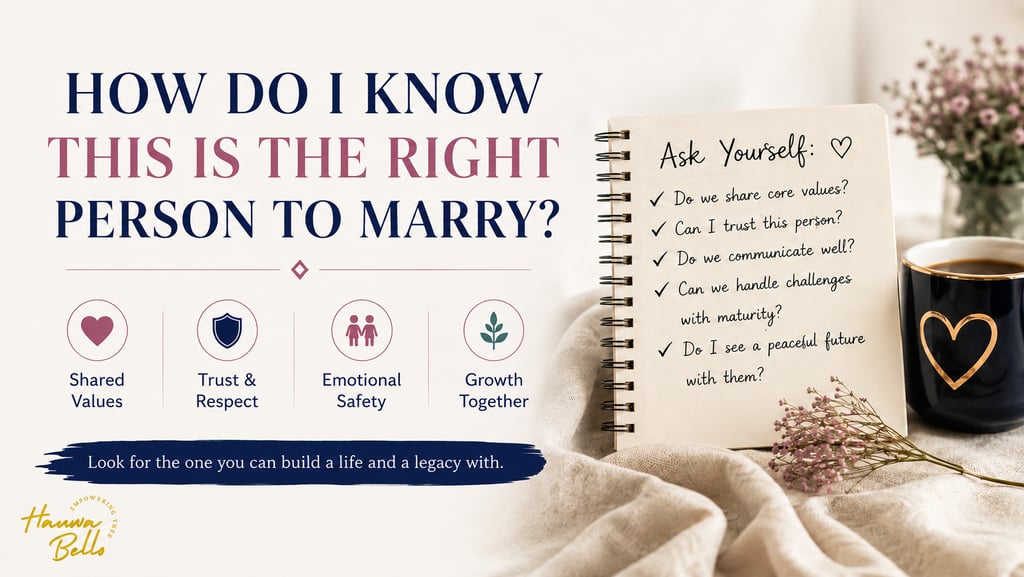
How do you know someone is truly the right person to marry? This post explores the signs of a suitable spouse, including shared values, emotional safety, trust, character, compatibility, and the wisdom of asking the right pre-nikah questions before making a lifelong decision.
MARRIAGE AND RELATIONSHIPS
Hauwau Bello
7/10/202611 min read
Are they the one?
In the previous post, we looked at a very important question: How do you know you are ready for marriage?
But after readiness comes another question. Maybe an even more delicate one.
How do I know this is the right person to marry?
This is the question many people carry quietly.
Sometimes they are already speaking with someone. Sometimes families are involved. Sometimes emotions have entered the matter. Sometimes there is pressure from parents, friends, age, or fear of starting again.
And sometimes, from the outside, the person looks suitable.
They are from a good family.
They have a decent job.
They seem religious.
They are polite.
They are attractive.
They are available.
People are already saying, “This is a good person. What else are you looking for?”
But marriage is more than finding someone who looks good on paper.
Marriage is about choosing someone you can build a life with.
It is about choosing someone whose character, values, emotional maturity, faith, and direction can meet yours in a way that brings peace, not constant confusion. It is about choosing someone you can trust with your heart, your dignity, your future, and, by Allah’s permission, your family.
So how do you know?
You may never know with absolute certainty. Human beings are not formulas. Marriage always requires tawakkul. But you can look for signs of readiness, compatibility, emotional safety, and shared direction.
You can slow down enough to see clearly.
First, Know Yourself Before Choosing Someone Else
Before asking, “Is this the right person?” you need to ask, “Do I understand myself enough to choose wisely?”
Because if you do not know yourself, you may confuse attraction for compatibility. You may confuse attention for love. You may confuse pressure for readiness. You may confuse potential for reality.
Self-awareness helps you ask better questions.
What kind of marriage do I want?
What kind of home gives me peace?
What values matter deeply to me?
What are my emotional needs?
What are my weaknesses?
What kind of partner brings out my maturity?
What kind of person triggers my wounds?
What are my non-negotiables?
What am I willing to be flexible about?
A person who does not know themselves may choose based only on beauty, money, tribe, family status, charm, or excitement. These things may have a place, but they cannot carry the weight of marriage.
Marriage requires more than attraction.
It requires fit.
The Right Person Should Share Your Core Values
One of the strongest signs that someone may be a suitable spouse is shared core values. Core values are the things that shape how you live, how you make decisions, and how you treat people. For a Muslim, deen should sit at the centre of this. But deen is more than appearance. It is more than language. It is more than social media posts, Islamic phrases, or public reputation.
Look for how the person lives their faith.
How do they speak when they are angry?
How do they treat people who cannot benefit them?
How do they handle money?
How do they respond to correction?
Do they take responsibility?
Do they respect boundaries?
Do they honour family without allowing unhealthy interference?
Do they understand marriage as an amanah?
Do they care about halal and haram in practical life?
Do they have humility before Allah?
Shared values may also include views about children, work, education, gender roles, finances, family involvement, privacy, community, lifestyle, and personal growth.
You do not have to agree on every small thing.
But the direction of your lives should make sense together.
If one person wants a quiet, faith-centred family life and the other wants a life of constant social exposure, secrecy, or emotional carelessness, the marriage may struggle. If one person values accountability and the other avoids responsibility, the marriage may become heavy. If one person wants growth and the other mocks growth, the marriage may feel lonely.
Shared values do not remove every challenge, but they give the marriage a stronger foundation.
The Right Person Feels Emotionally Safe
Emotional safety is one of the clearest signs to pay attention to. Ask yourself:
Can I speak honestly with this person?
Can I express concern without being punished?
Can I disagree without being insulted?
Can I ask questions without being made to feel foolish?
Can I be myself without walking on eggshells?
Can this person listen?
Can this person apologise?
Can this person repair after conflict?
Emotional safety does not mean the person will always say what you want to hear. It means they can handle truth with maturity. It means you can bring your thoughts, feelings, needs, and fears into the relationship without constant shame, fear, or dismissal.
Pay attention to how you feel around them.
Do you feel calm or constantly anxious?
Do you feel respected or managed?
Do you feel heard or silenced?
Do you feel valued or tolerated?
Do you feel spiritually encouraged or emotionally drained?
Sometimes the body notices what the mind is trying to explain away.
If you keep feeling tense, confused, small, afraid, or emotionally unsettled around someone, pause and reflect.
Peace is very important.
The Right Person Has Character, Not Just Charm
Charm can be very convincing. Some people know how to speak well. They know how to make promises. They know how to present themselves. They know how to impress your family. They know how to sound religious, serious, romantic, or mature. But charm is not the same as character. Character is what remains when the performance is over. Look at consistency.
Do their actions match their words?
Do they keep promises?
Are they truthful in small things?
Do they speak respectfully about others?
Do they manage anger responsibly?
Do they show kindness without needing an audience?
Do they take accountability without blaming everyone else?
Do they treat waiters, drivers, cleaners, younger siblings, staff, and people under their authority with dignity?
Many people focus only on how the person treats them during the talking stage. But also look at how they treat others.
A person who is cruel to others may eventually bring that same cruelty into the marriage. A person who is dishonest with others may eventually be dishonest with you. A person who avoids responsibility in other areas may bring that pattern into family life. Character is one of the strongest predictors of safety in marriage.
The Right Person Can Handle Conflict With Maturity
Every marriage will face conflict. The question is not, “Will we disagree?” The question is, “How do we disagree?” A suitable partner does not need to be perfect. But they should have the capacity to handle tension with some level of maturity.
When there is a misunderstanding, do they listen or attack?
When they are hurt, do they communicate or punish?
When they are corrected, do they reflect or become defensive?
When they make a mistake, do they apologise or justify?
When things are difficult, do they disappear?
When there is conflict, do they threaten the relationship?
Marriage will test both people. There will be tired days, money stress, family stress, pregnancy and parenting stress, health issues, career pressure, disappointment, and seasons where love needs effort. A person who can repair is a gift. A person who can say, “I was wrong,” is a gift. A person who can discuss hard things without humiliating you is a gift. A person who wants to grow is a gift.
Ask, “Can we repair after difficulty?" Not sweep things under the carpet.
The Right Person Respects Your Boundaries
Before marriage, boundaries reveal a lot. A person who respects you will respect your pace, your values, your body, your family process, your faith, and your need for clarity.
They will not pressure you into secrecy.
They will not push you into haram.
They will not rush you to ignore concerns.
They will not make you feel guilty for needing time.
They will not demand access to your private life before trust has been built.
They will not punish you for having standards.
Someone who truly wants marriage with honour will also want the process to have honour. This is especially important in our culture, where families may become involved quickly, and people may feel embarrassed to pause once introductions have started.
But it is better to pause before marriage than to enter a lifetime commitment with unanswered concerns.
A person who respects your boundaries before marriage is more likely to respect your dignity inside marriage.
The Right Person Is Someone You Can Trust
Trust is not built on words alone; it is built on consistency.
Can you believe what this person says?
Do they explain things honestly?
Do they hide major information?
Do they avoid difficult conversations?
Are they transparent about important matters?
Do they have a pattern of betrayal, manipulation, or secrecy?
Trust does not mean you must know every detail of their past. People deserve dignity and privacy. But anything that directly affects marriage should be discussed with wisdom and honesty.
This may include previous marriage, children, major debts, serious health concerns, fertility issues that are already known, addictions, legal concerns, family obligations, and other matters that would shape married life.
A marriage built on concealment begins with instability.
A suitable person may have a past, as many people do. What matters is honesty, repentance where needed, maturity, and present character.
Trust grows when words and actions keep meeting each other.
The Right Person Is Someone You Can Commit To
Attraction is important. Liking the person is important. Enjoying their company is important. But marriage also requires commitment.
Ask yourself:
Can I see myself choosing this person beyond the excitement of the beginning?
Can I honour this person in public and private?
Can I be patient with their human imperfections?
Can I build with them?
Can I support their growth?
Can I accept the parts of their life that will become part of mine?
Can I respect their family while maintaining healthy boundaries?
Can I imagine building a home, making decisions, raising children, and facing life’s tests with this person?
Commitment is not only about staying. It is about showing up.
It is about choosing repair. Choosing mercy. Choosing responsibility. Choosing loyalty. Choosing maturity.
A person may be good, but you may still feel unable to commit to them. That is worth paying attention to.
Good person does not always mean right person for you.
The Right Person Is Compatible With Your Life Direction
Marriage is not only about how you feel today. It is also about where both of you are going.
Do your life directions make sense together?
Where do you want to live?
How do you both see work and career?
How do you both see parenting?
What kind of Islamic environment do you want for your home?
What role will extended family play?
How do you both handle money?
What are your expectations around household responsibilities?
What are your views on education, ambition, service, rest, and community?
Many couples avoid these conversations because they are enjoying the emotional connection. But these are the conversations that protect the future.
Love does not automatically solve differences in direction.
If one person wants children soon and the other is unsure, discuss it.
If one person expects the wife to leave work and the other expects to continue working, discuss it.
If one person wants to live close to parents and the other needs distance, discuss it.
If one person wants a private marriage and the other expects constant family involvement, discuss it.
If one person is financially disciplined and the other is careless with money, discuss it.
Clarity is a mercy.
The Right Person Brings Out a Better Version of You
Pay attention to who you are becoming around the person.
Do they encourage your deen?
Do they inspire emotional maturity?
Do they support your goals?
Do they respect your healing?
Do they make you want to be more honest, patient, responsible, and grounded?
Or do you become more anxious, insecure, secretive, reactive, disconnected from Allah, or confused around them?
A healthy relationship does not make you perfect. But it should support your growth.
It should not pull you away from your values.
It should not make you abandon your dignity.
It should not make you shrink.
The right person should make goodness easier, or at least more possible.
Attraction Matters, But It Should Not Lead Alone
Attraction matters in marriage. It is okay to want to be drawn to the person you are marrying. It is okay to want warmth, affection, and companionship. Islam recognises human nature. Marriage is not meant to be only a duty without tenderness. But attraction should sit beside wisdom.
Sometimes people are strongly attracted to someone who is emotionally unsafe. Sometimes chemistry is confused with compatibility. Sometimes the very person who activates anxiety feels exciting because the nervous system recognises intensity, not peace. So yes, attraction matters.
But ask deeper questions too.
Do I respect this person?
Can I trust this person?
Do we share values?
Can we communicate?
A beautiful face cannot carry a difficult character. A charming voice cannot replace emotional safety, and strong attraction should be guided by clear thinking.
Use Guided Questions Before You Decide
One of the most helpful things you can do before marriage is ask the right questions.
Many people enter marriage after discussing attraction, family background, work, and general expectations, but they leave deeper matters untouched. They do not ask enough about values, emotional needs, money, family boundaries, conflict, faith, children, healing, responsibilities, and future direction.
Yet these are the areas that shape daily married life.
This is one of the reasons I created the Pre-Nikah Card Deck. It contains over 160 guided questions across different areas of marriage preparation. The questions are designed to help intending couples slow down, reflect, talk honestly, and notice whether they are aligned in the areas that matter.
It is not meant to create fear or overanalyse the relationship. It is meant to support clarity.
Sometimes one question can reveal a value.
One answer can open an important conversation.
One discussion can help a couple see what they need to address before marriage.
If you are considering someone for marriage, or you are already in the pre-nikah process, you may find the card deck helpful as a conversation guide.
You can order it here: Pre-Nikah Card Deck
Marriage should be entered with du’a, wisdom, consultation, and honest conversation. The more intentional the conversations before marriage, the better the couple can prepare for the life they hope to build together.
Do Istikhara and Seek Wise Counsel
In our deen, we are taught to seek Allah’s guidance. Istikhara is not only for when things are confusing. It is a way of placing our decision before Allah, acknowledging that He knows what we do not know.
Pray istikhara. Make du’a. Ask Allah to open what is good and gently close what will harm your dunya and akhirah. But also use the means Allah has given you.
Ask questions.
Observe character.
Speak to trusted people.
Do background checks in a dignified way.
Involve wise family members or mentors.
Seek premarital counselling where possible.
Some people think tawakkul means ignoring signs. Real tawakkul includes effort, wisdom, consultation, and then reliance upon Allah.
If concerns keep appearing, pay attention.
If trusted people are raising consistent warnings, listen.
If your heart is unsettled because there are serious character issues, slow down.
Peace is not always loud, but confusion can be very instructive.
Some Signs to Take Seriously
There are some signs that deserve careful attention before marriage.
Repeated lying.
Explosive anger.
Controlling behaviour.
Disrespect for your boundaries.
Mocking your faith or values.
Pressuring you into secrecy or haram.
Cruelty to others.
Addictions that are being hidden or denied.
Refusal to take responsibility.
Constant blame.
Emotional manipulation.
Isolation from trusted people.
Major financial irresponsibility.
Dishonesty about past or present obligations.
A pattern of disappearing and returning without accountability.
Public religiosity with private harshness.
No one is perfect. But patterns matter.
Do not ignore what is repeated.
A single mistake can be discussed. A consistent pattern should be taken seriously.
So, How Do You Know?
You may have found a suitable person when there is enough clarity in these areas:
Their deen is sincere enough to shape their character.
Their values make sense with yours.
Their words and actions are consistent.
You feel emotionally safe enough to be honest.
You can discuss difficult topics with maturity.
You can trust their character.
You can respect them.
You can commit to them.
You are attracted to them enough for marriage.
Your life directions are reasonably compatible.
They honour your boundaries.
They bring out a more grounded version of you.
Your concerns have been addressed with honesty, not dismissed.
Your decision feels guided by clarity, not panic.
This does not mean there will be no fear. Marriage is a major decision, and some nervousness is normal. But there is a difference between normal nervousness and deep unease. There is a difference between humility before a big step and your inner self warning you to slow down.
Listen carefully.
Final Reflection
Choosing a spouse is one of the most important decisions many people will make.
It affects your peace.
It affects your worship.
It affects your emotional wellbeing.
It affects your future children.
It affects your family system.
It affects the kind of home you will wake up in every day.
So take it seriously.
Do not choose only because people say the person is good.
Do not choose only because your age is moving.
Do not choose only because the person has money.
Do not choose only because there is attraction.
Do not choose only because the families are excited.
Choose with self-awareness.
Choose with istikhara.
Choose with consultation.
Choose with emotional maturity.
Choose with honesty.
Choose with your eyes open.
And when you are asking, “Is this the right person to marry?” remember to ask:
Can I trust this person? Can I commit to this person? Do we share enough values to build a life together?
Is there emotional safety here? Does this person help me move closer to the kind of life that pleases Allah?
Because the right person is not simply the person who wants to marry you.
The right person is the person with whom you can build a marriage of amanah, sakinah, mercy, responsibility, and growth.
May Allah guide every sincere heart to what is good, protect us from what is harmful, and grant us homes filled with peace, mercy, and barakah. Aameen.
Hauwa Bello, psychotherapist
My office
No 7, Christian Chukwu Street, 1421 Road, Gwarinpa Estate. Gwarinpa. Abuja. FCT