Khair Always In shaa Allah!

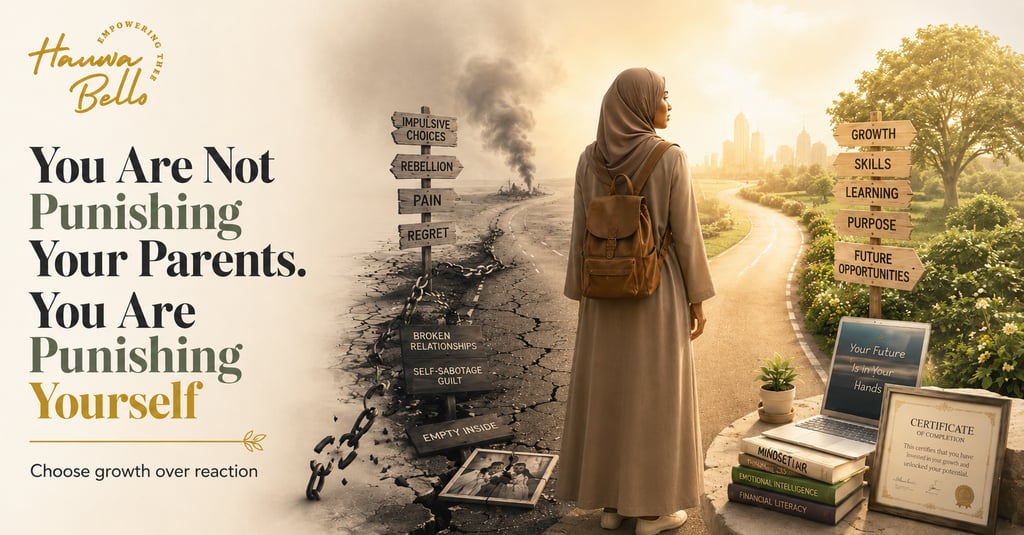
You Are Not Punishing Your Parents. You Are Punishing Yourself.
When young people reject good advice because they are angry with their parents, they may feel like they are making a point. But sometimes, the person who pays the real price is the young person themselves. This post explores how anger, resentment, and rebellion can quietly become self-sabotage, and why your future is too precious to use as revenge.
PARENTING AND FAMILY LIFEMENTAL HEALTH & EMOTIONAL WELLNESS
Hauwa Bello
6/19/20268 min read

There is a pattern many teenagers and young adults go through, a season where almost everything a parent says feels irritating, controlling, unfair, or suspicious. Even when the advice is sound, the fact that it came from a parent can make it feel impossible to accept.
A parent says, "Go and learn this skill." The young person thinks, "You are trying to control me."
A parent says, "Stay away from smoking, drinking, or bad company." The young person thinks, "You think you can run my life."
A parent suggests a course, a training, an opportunity. The young person thinks, "When I brought my own idea, you did not support me. Now that this is your idea, I will not do it."
And then the resistance begins.
In the moment, it can feel like power. It can feel like a point being made. But the painful truth is this: many times, the point is being made with the young person's own future.
You Are Doing Yourself
When a young person refuses something good because they are angry with their parents, they may believe they are punishing the parent. But in reality, they are shaping their own life, and not always in the direction they intend.
Yes, your parents may feel embarrassed. They may feel disappointed. If your choices become visible enough, they may feel ashamed. People may even blame them for your behaviour. But at the end of the day, you are the one who lives inside the consequences of your decisions.
If you refuse to learn, you are the one who loses the skill.
If you refuse to study, you are the one who loses the opportunity.
If you begin smoking or drinking to prove a point, you are the one who exposes your body, your mind, your reputation, and your future to everything that comes with it.
If you reject a good opportunity because you dislike the person who suggested it, you are the one who misses it.
That is the thing many young people miss in the heat of the moment. Anger can be valid. Pain can be real. But self-sabotage is expensive, and the price is paid in your own currency.
Some Parents Have Genuinely Hurt Their Children
This conversation cannot be honest unless we acknowledge something first.
Not every parent has acted wisely or lovingly. Some have been harsh, absent, emotionally unavailable, controlling, inconsistent, or unfair. Some children have felt ignored, controlled, compared, shamed, insulted, misunderstood, or unsupported. Some grew up in homes where their own dreams were dismissed, but later, the same parents expected them to follow whatever path they suggested. Some young people are carrying real wounds, wounds that were not their fault and that were never properly addressed.
That pain is real, and it deserves to be named.
But even when the pain is real, there is still a hard question that eventually has to be faced:
Do I want my pain to keep making decisions for me?
Because sometimes, in trying to prove how much a parent hurt us, we begin to hurt ourselves in ways that continue long after the original wound. The parent may have moved on. Life may have moved on. But the consequences of the choices we made in reaction stay with us.
We are not dismissing what was done to you. We are asking whether what was done to you should also determine what you do to yourself.
Why Young People Do This: The Psychology Behind It
This pattern reflects a need for control.
When a young person feels chronically unheard, dismissed, or managed without being respected, resistance can become the only language available. It becomes a way of saying, "I still have power over something."
And often, it is not even the advice that is being rejected. It is the parent's authority, their tone, their inconsistency, their past behaviour, or the perceived hypocrisy of being told what to do by someone who did not always model what they preached.
The internal dialogue can sound like:
"You did not support me when I needed you. You cannot now tell me what to do."
"You hurt me. I will show you."
"You embarrassed me in front of people. I will embarrass you."
"You never cared about my dreams. Why should I care about what you want for me?"
At the emotional level, this can feel deeply satisfying. It feels like justice. It can even feel like self-respect.
But at the level of real life, of real futures and real consequences, it often becomes one of the most costly mistakes a young person can make.
The Cigarette That Was Meant for the Father
A father tells his teenage son: "Stay away from smoking and drinking."
The son is angry. Perhaps the father has been absent for years. Perhaps he has been harsh, or inconsistent, or hypocritical. So the son makes a decision. Not because he particularly wants to smoke, but because he wants the father to feel it.
"I will smoke. I will drink. Let people see what kind of father you are. Let them see the kind of son you raised."
For a while, the plan seems to work. The father feels embarrassed. Family members whisper. People talk. The son feels, for a moment, that he has made his point.
But then we must ask the questions that feelings tend to skip over:
Who is inhaling the smoke? Who is damaging his body? Who is building a habit that may take years to break? Who is losing focus? Who is risking addiction, the kind that does not care about your reasons for starting? Who is slowly forming an identity built around rebellion? Who carries this in their body and their life, long after the argument that started it has been forgotten?
The parent may feel shame for a season. But the child carries the habit.
The Course That Was Never Taken
A mother sees a training opportunity and tells her daughter, "This course will help you. Please register."
The daughter already knows the course is useful. It connects to her interests. It could sharpen a skill, expand her options, or build real confidence. But she also remembers something that remains unresolved between them.
"When I brought my own workshop idea to you, you dismissed it. You did not support me then. Now, you want me to follow your suggestion? I am not going."
In the moment, this feels like fairness. It feels like accountability.
But who misses the training? Who remains without the skill? Who may watch others move forward and quietly wonder why their own path feels so slow?
The mother may feel frustrated. But the daughter is the one who loses what could have helped her build something real.
The Grades That Became a Battlefield
Some young people take this pattern into their education.
"My parents have never supported me emotionally. I am tired of trying to make them proud. Let them see what happens when they refuse to show up."
The parent may be angry. They may be disappointed. They may even feel regret. But the young person is the one who may later face limited options, closed doors, or the slow erosion of confidence that comes from years of underinvestment in themselves.
Your education is too important to become the place where your pain goes to make a statement. The school, the training, the opportunity: these were never your parents' property. They were always yours. Using them as weapons against someone else means you are the one who is unarmed when it matters.
Staying in Bad Company to Avoid Admitting They Were Right
There is another version of this that is very common, and perhaps more quietly painful than the others.
A teenager keeps a group of friends whose parents have clearly warned them about. Not necessarily because those friends are genuinely good for them nor because the connection is truly nourishing. But because leaving would feel like conceding something.
"If I walk away from this group, my parents win."
So they stay. And sometimes, what they stay in costs them far more than any argument was worth.
One of the most difficult things a young person can learn to do is separate wisdom from the person delivering it. To be able to say, "My parents were right about this one," without feeling like that erases their own agency or validates everything else that hurt them.
Wisdom is not surrender. Choosing what protects your life, even when the advice came from someone you are angry with, is one of the most mature things a person can do.
When the Wound Is With the Messenger, Not the Message
For those reading this from within a Muslim framework, there is a version of this that touches something deeper.
Some young people, hurt by parents who raised them in the deen, begin to pull away from the values themselves. They do so because they can no longer separate the message from the pain surrounding the messenger.
"My parents prayed five times a day. Look at how they treated me."
"They taught us Islam, but the home was not a place of peace."
The confusion behind this is understandable. When someone who claimed to embody a value also wounded you, the value itself can start to feel contaminated. Faith, modesty, discipline, family: these can all begin to feel like things that belong to a world that hurt you.
But it is worth asking gently: does a parent's failure to live a value fully cancel the value itself?
If prayer has been a source of peace and clarity for you, does it stop being that because someone who prayed also disappointed you? If honesty, or patience, or responsibility has served your own growth, does it lose that power because the person who taught it was imperfect?
Take what is good. Heal from what hurt. Learn, over time, to separate the message from the wounds that sometimes surround it. This is not easy work. But it is some of the most important work there is.
Better Questions to Ask Yourself
The shift from reactivity to wisdom often begins with changing the question.
Instead of asking: "Will this hurt my parents?"
Ask:
Will this help my life?
Will I be proud of this choice in five years?
Am I rejecting this because it is genuinely wrong for me, or because I am angry?
If this same advice came from someone I respected, would I consider it?
Who will carry the consequence of this decision, and for how long?
Am I choosing something, or am I reacting to something?
These questions don't dismiss your feelings; rather, they are questions that refuse to let your feelings be the only voice in the room.
A Word for Parents
This conversation has another side.
Parents also need to hear their part. Young people often resist good advice not because the advice is wrong, but because of how it arrives: wrapped in shame, delivered with harshness, or offered inconsistently by someone who did not apply the same standard to themselves.
A good message can be lost entirely when it is delivered in a way that humiliates or controls. Parents who want to genuinely guide their children have to learn to do so with respect, to correct without crushing, to advise without condescending, and to make room for the child's own voice and ideas, not only the ones they personally approve of.
Guidance that feels like a partnership lands differently than guidance that feels like a verdict.
But even when parents have significant room to grow, and many do, young people still need to reckon with the fact that their choices become their own lives. The person who delivers the advice and the wisdom within it are two separate things. Both can be true at once.
Your Future Is Too Precious to Use as Revenge
You may have real grievances. Some of them may run deep. Some of what happened to you may have been genuinely unfair, and the people who should have done better by you did not.
That is real. That matters.
But your future is too precious to use as revenge.
Your education is too precious. Your health is too precious. Your character is too precious. Your faith is too precious. Your opportunities are too precious. The time you have, which is not unlimited, is too precious.
You deserve a life built on wisdom and intention, not reaction. You deserve to make choices that serve your growth, your peace, and the person you are becoming, not choices that are shaped primarily by wanting someone else to feel something.
So before you reject something good simply because it came from your parent, pause long enough to ask yourself the real question:
Am I actually punishing them?
Or am I about to punish myself?
The goal is not to always obey. It is not to pretend the pain was not real or that every parent has been wise. The more honest message is this: even when your feelings toward your parents are complicated, do not use your own life as the place where you punish them. Learn to separate the advice from the person, the opportunity from the conflict, and your future from your anger.


Hauwa Bello, psychotherapist
My office
No 7, Christian Chukwu Street, 1421 Road, Gwarinpa Estate. Gwarinpa. Abuja. FCT