Khair Always In shaa Allah!

Why We Need Emotional Safety Before Healing Can Begin
Healing often begins before the deep conversations, big decisions, or visible changes. This post explores why emotional safety is the first step in recovery, and how feeling seen, heard, and treated with dignity helps the heart and mind begin to heal.
TRAUMA, SAFETY & HEALING
Hauwa Bello
3/27/20266 min read
There is a particular kind of exhaustion that comes not from the wound itself, but from being handed a roadmap to recovery before anyone has acknowledged that you are hurt.
We do this often, and usually with love. We tell people to forgive. We remind them to be strong. We encourage them to pray more, to think less, to move forward. And behind most of these responses is genuine care. But for the person still living inside the pain, these invitations can arrive like a weight on an already heavy chest. Not because the words are wrong, but because they come too soon. Before the person has been seen. Before they feel safe enough to breathe.
Healing begins with safety.
What Emotional Safety Really Means
Emotional safety is a felt sense, something the body and the heart register before the mind names it. It is the experience of bringing your pain into a space, a conversation, a relationship, and still being treated with dignity, held with care, and still being you, unedited and unafraid.
It includes the small things that add up: honesty that does not wound, privacy that is honoured, patience that does not rush, and the simple act of being heard without shame or blame attached to what you share.
Emotional safety can be internal or relational, and usually it is both. A person who has been deeply hurt may not feel safe inside their own mind. They carry the inner critic, the self-blame, the replaying of what went wrong. And they may also be moving through relationships or spaces where pain is treated as inconvenient, weakness is penalised, or silence is expected. Both forms of unsafety are important. Both make healing harder.
Why the Nervous System Needs Safety First
The body keeps a record of what the mind tries to manage. When a person consistently feels unsafe, emotionally or relationally, the nervous system responds. It does what it was designed to do: it moves toward survival.
Survival mode does not always look like panic. It can be quiet. It can look like withdrawal, like numbness, like a vague sense of disconnection from everything that used to matter. It can look like irritability that even surprises the person experiencing it. It can look like people-pleasing, saying yes when the body is screaming no. It can look like an emotional shutdown, where a person functions on the outside while something important has gone dark on the inside.
A person in survival mode is being human, and the cost is real. When the system is oriented around protection, the deeper work becomes harder to reach. Reflecting on what happened, communicating honestly, praying with presence, receiving guidance, and making clear decisions all require a quality of inner availability that survival mode cannot easily offer. The nervous system is busy with something else.
This is a physiological meeting of circumstances. And it is why safety must come first.
What Happens When People Are Rushed Out of Pain
Many people are rushed out of pain long before they have been understood. They are told things like:
“Just move on.”
“Stop thinking about it.”
“At least it was not worse.”
“Other people have suffered more.”
“You need to forgive.”
“Don’t talk about it too much.”
“Pray and forget about it.”
“Don’t bring shame to the family.”
Sometimes people say these things because they feel helpless. Sometimes they are uncomfortable with another person’s pain. Sometimes they were raised with the belief that strength means silence. Sometimes they truly think they are helping.
But when pain is rushed, it often goes underground.
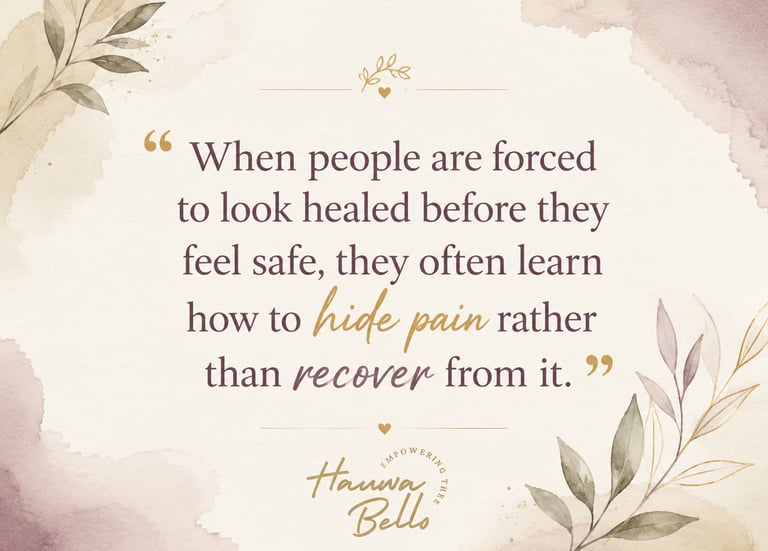
Many people become very skilled at appearing fine. They learn to perform strength even when they are carrying things that feel unbearable. They learn to speak the right language in the right spaces, to present the composure that is expected, to protect the image that others need to see. They do this out of necessity. Because the spaces around them have communicated, directly or indirectly, that pain is something to be resolved quickly, that grief should not linger, that struggle is a private matter to be tidied away.
In many families and communities, this pressure is real and layered. There is the weight of reputation. The need to protect collective peace. The unspoken rule is that some feelings should not be spoken about at all. So people learn to carry their pain quietly, and eventually, they carry it alone.
The consequences accumulate over time. Silence becomes a habit. Shame attaches to the pain itself, as though feeling it is the problem. Emotional distance grows in the places where closeness was meant to live. And the distress that was never given a proper home finds other ways to surface, through the body, through conflict, through crisis, when the weight finally becomes too much.
Rushing people out of pain does not make the pain disappear. It teaches them to hide it better.
This is especially important in cultures where family reputation, religious language, respectability, and endurance are highly valued. These values can be beautiful when joined with mercy and justice. But when they are used to silence pain, they can make healing harder.
A person should be able to say, “I am hurting,” and still be treated with honour. A child should be able to say, “I am scared,” and be met with care. A spouse should be able to say, “This hurt me,” and be heard with humility. A client should be able to say, “I am struggling,” and be received with steadiness. A believer should be able to say, “My heart feels heavy,” and be reminded of Allah’s mercy with gentleness, patience, and wisdom.
Why Emotional Safety Matters Across Every Space
The need for emotional safety does not belong to one domain of life. It shapes what becomes possible everywhere people are expected to be honest, open, and present.
In therapy, safety is the difference between performance and genuine exploration. A client who does not feel safe will manage the session rather than inhabit it. They will give the answers that feel acceptable rather than the truths that need tending. The real work begins only when the space itself communicates that there is nothing here that will be used against you.
In families, emotional safety creates the conditions for people to speak before silence becomes a wall. When family members, especially children and young people, know that their honesty will be met with care rather than judgment or punishment, they come forward with what they are carrying. So much pain becomes a crisis only because it was not allowed to be a conversation early enough.
In marriage, emotional safety is the ground on which repair becomes possible. Couples who feel safe with each other can acknowledge harm, receive honesty, and move toward each other rather than into defensive positions. When safety is absent, conflict calcifies. Words that need to be said stay unsaid, and distance becomes the only solution both people know.
In faith spaces, emotional safety allows people to encounter mercy rather than manage appearances. When a person in pain walks into a community space, a halaqah, a jumu’ah, a counselling session grounded in Islamic guidance, and finds that their complexity is welcomed rather than simplified, they begin to experience the rahma they have been taught to believe in, not as an abstraction, but as something practised and felt. Dignity is not just taught in such spaces. It is demonstrated.
In Islam, the human being is treated with dignity. The heart matters. Mercy matters. Amanah matters. The way we handle another person’s pain is part of our responsibility before Allah.
The Prophet ﷺ was sent as a mercy, and his way with people was marked by gentleness, patience, wisdom, and deep concern. He saw people beyond their behaviour. He listened. He guided. He corrected with wisdom. He carried responsibility without harshness.
That Prophetic example matters when we speak about emotional safety. When someone brings us their pain, they are trusting us with something delicate. A person’s pain is an amanah. Their story is an amanah. Their dignity is an amanah. Their vulnerability is an amanah.
Safety Is the Beginning of Deeper Healing
Emotional safety is not a detour from healing. It is the ground from which healing becomes possible at all. A person who feels safe can begin to move. From survival to reflection. From silence to language. From carrying pain alone to sharing it with someone who will not flinch. From shame to something gentler, something closer to honesty and, eventually, to peace.
This does not mean every space must be without challenge, or that difficult truths should be withheld in the name of comfort. Safety is not the same as softness. It is the quality of presence that makes truth-telling feel survivable. When we offer that to one another, we are not replacing healing. We are creating the conditions for it to begin.
A Gentle Place to Begin
Sometimes the first act of healing is simple.
It is admitting, “I am hurting.” It is noticing, “I feel guarded here.” It is asking, “Who can hold this with care?” It is allowing yourself to seek help before things become unbearable. It is choosing one trustworthy person, one safe room, one honest sentence, one small step toward support.
Healing does not always begin with a breakthrough. Sometimes it begins with a breath. A pause. A quiet moment of honesty. A conversation where someone finally listens well. A prayer whispered from a tired heart. A therapy session where the person realises, “I do not have to carry this alone.”
Before healing can deepen, safety must be restored. And sometimes, the most powerful gift we can offer another person is this simple message:
Your pain is safe with me.
This is the first article in a two-part series on emotional safety and healing. In the next post, we will explore how to create emotional safety for yourself and for the people who trust you with their pain.

Hauwa Bello, psychotherapist
My office
No 7, Christian Chukwu Street, 1421 Road, Gwarinpa Estate. Gwarinpa. Abuja. FCT