Khair Always In shaa Allah!

The Al-Wakīl Tawakkul Checklist
This Tawakkul Checklist is a practical guide for anyone who is doing their best but still feels stuck in overthinking, re-checking, and carrying outcomes that are not theirs to carry. Rooted in Al-Wakīl, it helps you tie your camel with responsibility, then hand over the rest with trust. Use it to move from hypervigilance into selective focus, so you can act with integrity and then rest with peace.
RAMADAN 2026/1447
Hauwa Bello
3/13/20261 min read
The art of the sacred hand-off
“Tawakkul is not a substitute for action. It is the healthy surrender that follows it.”
Hauwa Bello
Phase 1: Tie the camel
Responsibility
Before we let go, we check whether we have done what is actually within our jurisdiction.
Tick what applies:
Have I taken the first logical step? Action over avoidance.
Have I used the resources available to me right now? No waiting for perfect conditions.
Is my intention aligned with my values? Checking the why, not only the what.
Have I consulted wisely or made a wise-mind plan? Preparation without panic.
Phase 2: Delegation
Handing over the lead
Once Phase 1 is complete, we have reached the edge of our control. This is where tawakkul becomes real.
Acknowledge the limit:
Say clearly: “I have done what is humanly possible in this moment.”Name the uncontrollables:
Write what you cannot control, such as timing, other people’s reactions, outcomes, systems, results.Formal hand-off:
Say (silently or out loud):
“Yā Wakīl, I resign as the manager of this outcome. It is now in Your care.”
Phase 3: Monitoring guardrails
Protecting your peace
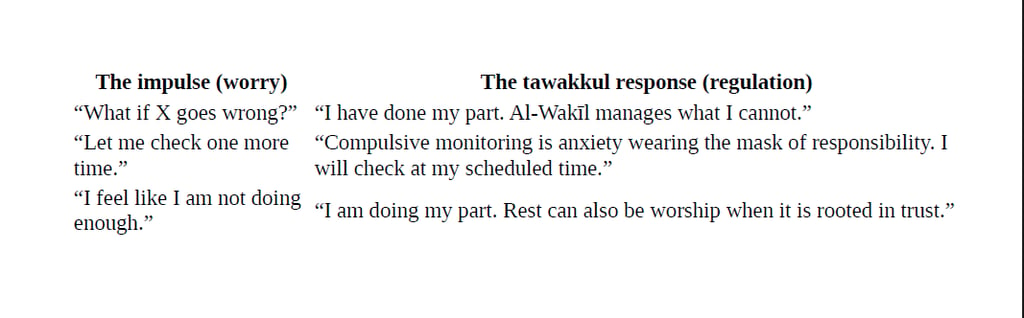
Often, the hardest part is not letting go. It is staying, let go. Use these guardrails to stop the re-checking loop.
Therapeutic note: the 90-second rule
When the urge to re-capture the worry hits, stay with the discomfort for 90 seconds without acting on it. Let the wave peak and recede. Every time we do not check, we retrain the nervous system for peace. This is also patience training.
“Allah is sufficient for us, and He is the Best Trustee.”
(Qur’an 3:173)


Hauwa Bello, psychotherapist
My office
No 7, Christian Chukwu Street, 1421 Road, Gwarinpa Estate. Gwarinpa. Abuja. FCT