Khair Always In shaa Allah!

The Al-Khabīr Blind Spot Discovery Worksheet
This worksheet is designed to help us move from secrecy to awareness, applying the quality of Al-Khabīr (The All-Aware). In clinical practice, we use the Johari Window to explain that we all have blind spots. These are parts of our behaviour that others can see, but we struggle to see in ourselves. When blind spots remain hidden, they quietly sustain cycles through self-deception, minimising, and rationalisation. When they are brought into the light, we regain choice. That is where liberation begins.
RAMADAN 2026/1447
Hauwa Bello
3/9/20262 min read
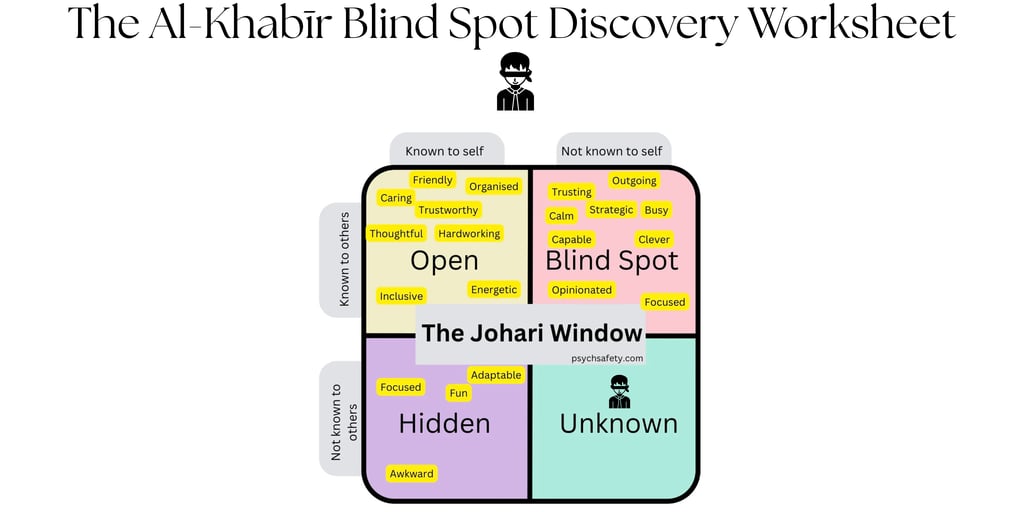
“O Al-Khabīr, expose my blind spots without humiliating me.”
Hauwa Bello
Step 1: The External Perspective
The mirror
Because blind spots sit outside our own view, we often need mirrors to see them. Think about the feedback you have received from a trusted person recently.
The feedback: What is one observation people close to you have repeated more than once?
Examples:
“You get defensive when corrected.”
“You withdraw when things get difficult.”
“You over-explain instead of listening.”
“You avoid difficult conversations.”
“You go silent when you are hurt.”
Your first reaction: Did you immediately justify, deny, or explain it away?
Note it honestly. Denial often protects the blind spot.
Step 2: The Internal Inquiry
The hidden motive
Al-Khabīr is aware of inner states and hidden motives. Ask yourself the Day 19 question:
What am I avoiding admitting to myself?
Examples:
“I am avoiding admitting that I feel jealous.”
“I am avoiding admitting that I use busyness to avoid intimacy.”
“I am avoiding admitting that I am afraid of being seen as inadequate.”
“I am avoiding admitting that I resent someone, so I punish them with distance.”
Write the most honest answer you can, even if it is uncomfortable.
Step 3: The Coherence Check
Finding the gap
Coherence is when our inner motive matches our outer action. Many blind spots live in the gap.
Outer action (what I did or said):
Example: “I told my friend I was too tired to help.”
Inner motive (what was really happening inside me):
Example: “I felt resentful about a past disagreement and wanted to punish them with my absence.”
The impact: How does this gap affect you?
Does it create guilt, anxiety, disconnection, confusion, or inner friction?
Does it damage trust in your relationships, including your relationship with yourself?
Step 4: The Strategic Disruption
A new response
Now that the blind spot is visible, it becomes workable. We move from shame to strategy.
Name the blind spot clearly:
Examples:
The Defensive Shield
The Avoidance Loop
The Control Grip
The Pleasing Mask
The Silent Punishment
The disruption plan: What is one small wise-mind action you will practise next time this blind spot is triggered?
Examples:
“When I feel the Defensive Shield rising, I will pause and say, ‘I hear you. Give me a moment to take that in,’ instead of arguing immediately.”
“When I want to withdraw, I will say, ‘I need 10 minutes to settle, then I will come back,’ instead of disappearing.”
“When I want to punish with silence, I will name the hurt directly and ask for what I need.”
Keep it small. Keep it realistic. We are building capacity, not perfection.
Clinical Insight
Safety over shame
Seeing a blind spot can feel vulnerable. But remember, we are held in mercy. Being seen is not a threat. It is truth. And truth is what allows us to regulate what was previously running on autopilot.
The Khabīr (awareness) Commitment
“I am no longer operating on autopilot. By naming my blind spots, I am reclaiming my power to choose differently.”


Hauwa Bello, psychotherapist
My office
No 7, Christian Chukwu Street, 1421 Road, Gwarinpa Estate. Gwarinpa. Abuja. FCT