Khair Always In shaa Allah!

Social Media and the Muslim Heart in a Noisy Digital World
This post explores the hidden impact of comparison, overstimulation, distraction, and validation-seeking, while offering practical Islamic tools such as salah, dhikr, Qur’an, gratitude, muhasabah, and mindful digital boundaries to help Muslims find balance in a noisy online world.
MENTAL HEALTH & EMOTIONAL WELLNESSFAITH, MINDFULNESS & SPIRITUAL GROWTH
Hauwa Bello
7/17/20269 min read
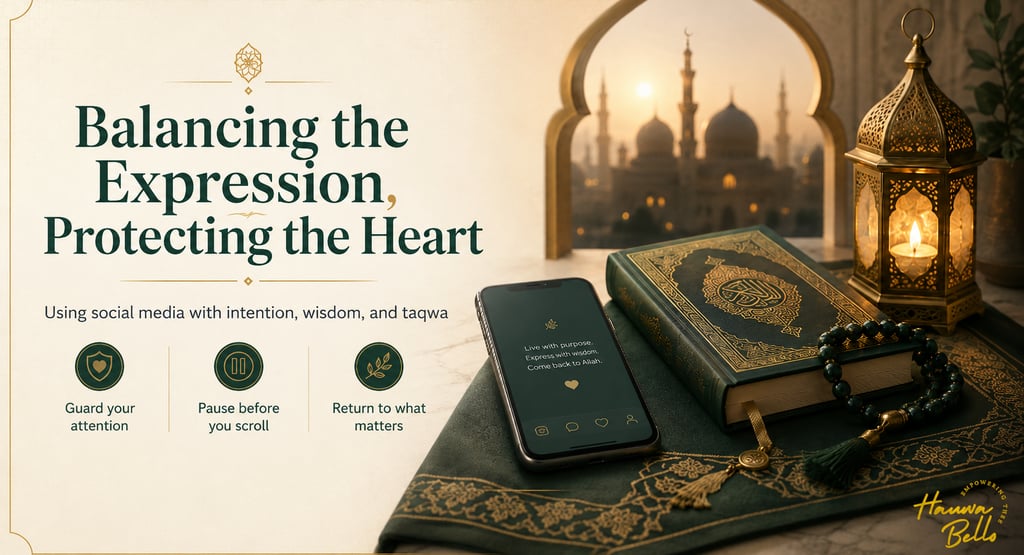
Social media is one of the great double-edged tools of our time.
It connects us, teaches us, informs us, gives us access to beneficial reminders, helps businesses grow, amplifies important causes, and allows the Ummah to communicate across borders in ways previous generations could hardly imagine.
At the same time, it can also drain us, distract us, feed comparison, increase anxiety, weaken presence in worship, and quietly pull the heart away from the very things that bring it peace.
The issue runs deeper than time spent on our phones. Our phones are training our attention.
And in Islam, attention is spiritually serious.
What we repeatedly look at, listen to, laugh at, desire, envy, fear, argue with, or admire begins to shape the heart. The eyes are not passive. The mind is not passive. The heart is not passive.
We may think we are “just scrolling,” but psychologically and spiritually, we are entering an environment.
That environment can either bring us closer to Allah, beneficial knowledge, meaningful connection, and purposeful action, or it can pull us into comparison, distraction, vanity, outrage, lust, fear, and spiritual numbness.
The phone may be in the hand, but the effect is often in the heart.
Why Does Social Media Pull Us Away From Inner Peace?
Allah tells us in the Qur’an:
“Verily, in the remembrance of Allah do hearts find rest.” Surah Ar-Ra’d 13:28
This verse teaches us something profound about the human heart. The heart was created to find rest in Allah. It settles through remembrance, worship, gratitude, trust, repentance, reflection, and nearness to Him.
But social media often creates the opposite rhythm.
It keeps the heart moving from one thing to another. One image. One opinion. One argument. One lifestyle. One tragedy. One achievement. One scandal. One reminder. One joke. One advert. One comparison.
The heart keeps jumping.
The mind keeps reacting.
The soul gets very little stillness.
This is why many people come away from social media feeling strangely tired, even when they have been physically resting. The body may be sitting still, but the mind has travelled through many emotional states in a short time.
A person may open an app for two minutes and see joy, grief, wealth, beauty, pain, conflict, luxury, religious reminders, political tension, marriage content, business pressure, and bad news all at once.
That is a lot for the nervous system.
It is also a lot for the heart.
The modern crisis is not only that we are distracted. It is that we are distracted from what should heal us.
The Mental Health Cost of Constant Scrolling
From a mental health perspective, a high social media presence can affect emotional wellbeing in several ways.
One of the most common is comparison.
Many people compare their private struggles with other people’s public highlights. They sit in their room, tired, lonely, overwhelmed, or uncertain about their future, then they scroll and see someone’s wedding, new house, glowing skin, thriving business, happy family, luxury holiday, or beautiful home.
Even when they are genuinely happy for others, the mind may quietly begin to ask:
“Why is my life not like this?” “Am I behind?” “Is something wrong with me?” “Why is everyone moving forward except me?” “Has Allah forgotten me?”
This is where social media becomes emotionally dangerous. It can make a blessed life feel inadequate simply because it is being compared to a carefully edited life.
A person may have health, family, iman, safety, food, shelter, friendship, and opportunities, but because the eyes are constantly exposed to what others have, the heart begins to feel deprived. Comparison weakens contentment. It makes gratitude harder. It can open the door to envy, sadness, shame, resentment, and anxiety.
Islam calls us to shukr, rida, and trust in Allah’s wisdom. Social media often trains the heart to measure life through visibility, speed, beauty, achievement, and applause.
That is a heavy burden for the soul.
When the Nervous System Becomes Exhausted
Another mental health effect of social media is overstimulation. The brain was not created for endless emotional switching. Yet online, we move rapidly between very different emotional experiences.
A funny video. A tragic story. A religious reminder. A luxury lifestyle post. A heated argument. A business advert. A friend’s announcement. A painful news update. A stranger’s opinion. A celebrity scandal. A motivational quote. A comment section full of anger. All of this may happen in a few minutes.
The person may close the app and wonder, “Why do I feel so heavy?”
The answer may be that the mind has absorbed too much. The nervous system has been activated again and again, but without enough time to process, regulate, or settle. This can contribute to anxiety, irritability, poor concentration, restlessness, sleep problems, emotional fatigue, and low mood.
Spiritually, this matters because an exhausted mind often struggles with presence in worship.
Sometimes a person thinks, “My iman is low,” when part of what is happening is that their mind is overstimulated, their sleep is poor, their attention is fragmented, and their heart has had very little quiet time with Allah.
The person may stand in salah, but the mind is still replying to comments. They may open the Qur’an, but part of them is waiting for a notification. They may make dhikr, but the heart is still busy with what it saw online.
Social media trains the mind to jump quickly. Salah invites the heart to settle.
The phone trains us to respond immediately. Salah trains us to return intentionally.
The Search for Validation
Social media can also create dependence on being seen. Likes, comments, shares, views, reactions, and reposts can begin to shape how people feel about themselves. A post that performs well may lift the mood. A post that receives little engagement may bring doubt, sadness, embarrassment, or even shame.
This is especially important for young people, public speakers, writers, entrepreneurs, therapists, teachers, influencers, and even Islamic content creators.
A post may begin with sincere intention. Over time, however, the heart may slowly become attached to applause. The person may begin to wonder: “Did people like it?” “Did enough people see it?” “Why did this person ignore it?” “Why is someone else growing faster?” “Am I still relevant?”
This is where the heart needs careful muhasabah. When the heart becomes addicted to being seen by people, it may struggle to find peace in being known by Allah.
The believer is allowed to use platforms. The believer can teach, build, sell, advocate, encourage, and share beneficial work online. But we must keep returning to intention.
Am I sharing to benefit? Am I sharing to express truth? Am I sharing to serve? Am I sharing for halal livelihood? Am I sharing for da’wah, education, or meaningful connection? Or has my heart become attached to praise?
Sincerity needs regular renewal, especially in a world where everything can be measured publicly.
The Spiritual Cost of Online Noise
A noisy online life can create a noisy inner life. When the heart is constantly exposed to arguments, fear, bad news, comparison, gossip, vanity, and outrage, it can become spiritually tired.
The online world often rewards reaction. Harshness spreads quickly. Anger spreads quickly. Scandals spread quickly. Fear spreads quickly. After consuming enough of this, a person may begin to feel unsafe, suspicious, hopeless, angry, or emotionally numb.
And when anxiety grows, spiritual perception can become distorted. A person may begin to feel far from Allah, even when Allah is near. They may feel abandoned, even when Allah’s mercy surrounds them. They may feel overwhelmed by dunya, even when the door of du’a remains open.
What repeatedly enters the eyes can eventually become the emotional weather of the heart.
This is why the believer must ask deeper questions.
Not only: “Is this content entertaining?” But: “What is this doing to my heart?”
Not only: “Is this halal?” But: “Is this making me more mindful of Allah, or more forgetful?”
Not only: “Can I watch this?” But: “What kind of person is this shaping me into?”
So What Is the Solution?
For some people, social media is part of their work, da’wah, education, business, advocacy, creativity, or community connection. The answer is usually discipline, not absence.
Islam asks us to live consciously. It teaches us adab, intention, boundaries, accountability, and remembrance.
We need to move from impulsive scrolling to intentional use.
The believer is called to engage the world with taqwa.
Salah as a Divine Interruption
One of the greatest resets Allah has given us is salah. Salah is not only an obligation to complete. It is a return.
It interrupts the noise of the world and calls the heart back to its Lord. It gives structure to the day. It gives the body a posture of humility. It gives the tongue words of worship. It gives the mind a recitation. It gives the soul direction.
Every salah is a divine interruption. It interrupts the dunya before the dunya consumes the heart.
One practical step is to put the phone away a few minutes before salah. Let the heart arrive before the body begins to pray. Even one minute of stillness before salah can make a difference. Pause. Breathe. Make wudu with awareness. Remind yourself: “I am returning to Allah now.”
That small pause can help the heart move from scrolling to presence.
Dhikr as a Reset for the Heart
Dhikr is another powerful reset. It is simple, but deeply transformative. Dhikr brings rhythm, repetition, breath, meaning, and spiritual anchoring.
When the heart feels heavy, say:
Astaghfirullah.
When anxiety rises, say:
Hasbiyallahu wa ni’mal wakeel.
When you feel overwhelmed, say:
La hawla wa la quwwata illa billah.
When the mind feels scattered, return to:
SubhanAllah. Alhamdulillah. Allahu Akbar.
Dhikr fills silence and purifies the inner conversation.
Many people are mentally exhausted because their inner conversation has been shaped by comparison, fear, pressure, shame, and noise. Dhikr gently returns that inner conversation to Allah.
Qur’an as Emotional Reorientation
Social media says, “Look at everyone.” The Qur’an says, “Look at Allah’s signs.”
Social media says, “You are behind.” The Qur’an reminds us that Allah gives with wisdom, timing, mercy, and knowledge.
Social media says, “React now.” The Qur’an calls us to patience, truthfulness, justice, humility, and trust.
The Qur’an does not only inform the mind. It reorders the heart.
A simple habit can help: before opening social media in the morning, read even a few verses of Qur’an.
Let Allah’s words enter your heart before the world’s noise enters your mind.
The first input of the day matters.
Muhasabah Before and After Scrolling
One Islamic practice we urgently need in our digital lives is muhasabah, self-accountability.
Before opening an app, ask:
“Why am I opening this?” “What am I seeking?” “Am I tired, lonely, bored, anxious, or avoiding something?” “Will this benefit me?” “Will this bring me closer to Allah or pull me into heedlessness?”
After scrolling, ask:
“How do I feel now?” “Did this increase my peace or reduce it?” “Did it trigger envy, lust, anger, fear, sadness, or comparison?” “Do I need to adjust what I consume?”
The problem is often unconscious entry, opening the app without knowing why. We enter without intention, then wonder why we leave without peace.
A believer’s online life needs intention.
Digital Fasting Without Disappearing
We can practise digital fasting without deleting everything.
This may mean:
Keeping the phone away before Fajr or after Maghrib.
Avoiding social media immediately after waking up.
Avoiding scrolling before sleep.
Keeping meals phone-free.
Keeping family time phone-free.
Putting the phone aside before salah.
Setting specific times to check messages.
Curating the feed with taqwa.
Following accounts that increase beneficial knowledge, humility, hope, sincerity, and usefulness.
Reducing accounts that constantly trigger envy, vanity, lust, anger, fear, or despair.
The algorithm studies our desires. Taqwa teaches us to discipline them.
Shukr as the Antidote to Comparison
When social media increases comparison, gratitude brings the heart back home. After seeing what others have, pause and name what Allah has already given you.
This trains the heart to see what is present, alongside what is missing.
You can say:
“Alhamdulillah for my health.” “Alhamdulillah for my family.” “Alhamdulillah for my iman.” “Alhamdulillah for food.” “Alhamdulillah for safety.” “Alhamdulillah for the chance to begin again.”
Comparison narrows the eye to what others have. Shukr widens the heart to what Allah has already given.
Your Feed Is a Form of Companionship
The Prophet ﷺ taught us that a person is upon the way of his close friend, so we should be careful who we take as close companions. In our time, companionship is not only physical.
The accounts we follow become part of our emotional and spiritual environment. The people we watch every day can shape our desires, standards, fears, speech, values, and idea of success.
Your feed is a form of companionship. Choose it with taqwa.
Ask yourself:
Who is shaping my view of success? Who is shaping my view of marriage? Who is shaping my view of beauty? Who is shaping my view of money? Who is shaping my view of Islam? Who is shaping my view of myself?
Not every voice deserves access to the heart.
Tawbah After Digital Slips
Many people feel ashamed after online slips. They waste time, argue harshly, look at harmful content, expose themselves to things that weaken them, show off, or become careless with their words.
The answer is not despair. The answer is return.
Tawbah is one of the greatest gifts Allah has given the believer.
If you fall, return quickly. Say istighfar. Make wudu. Pray if you can. Remove the trigger. Adjust the boundary. Keep moving.
The door back to Allah is wider than the screen that pulled you away.
Finally
Social media is a double-edged sword. It can spread knowledge, build connections, support da’wah, amplify good causes, grow businesses, and strengthen community. It can also feed comparison, distraction, anxiety, vanity, envy, outrage, and spiritual tiredness.
So the real question is not only:
“How much time do I spend online?”
The deeper question is:
“What kind of person is my online life shaping me into?”
Is it making me more grateful? More sincere? More present? More compassionate? More connected to Allah? More useful to people?
Or is it making me more anxious, distracted, reactive, envious, vain, and spiritually tired?
The phone is a tool. The heart is the trust.
The believer’s task is to hold this tool with taqwa, use it with intention, and return the heart again and again to Allah.
Because the heart was not created to be fed by endless scrolling.
The heart was created to know Allah, remember Allah, and find rest with Him.

Hauwa Bello, psychotherapist
My office
No 7, Christian Chukwu Street, 1421 Road, Gwarinpa Estate. Gwarinpa. Abuja. FCT