Khair Always In shaa Allah!

Ramadan Day 9
Day 9 invites you into the exquisite tenderness of Ar-Ra’ūf (The Most Compassionate)—like a gentle hand placed on a tired shoulder. While we’ve reflected on broad mercy and expansive love, Ar-Ra’ūf meets you in your weakest moments with a mercy that is refined, protective, and deeply soothing. This post bridges divine tenderness with the clinical power of recognising limits—helping you soften without collapse, and respond to fatigue with care instead of pressure.
RAMADAN 2026/1447
Hauwa Bello
2/26/20263 min read

Alhamdulillāh — Day 9.
As-salāmu ‘alaykum wa raḥmatullāhi wa barakātuh.
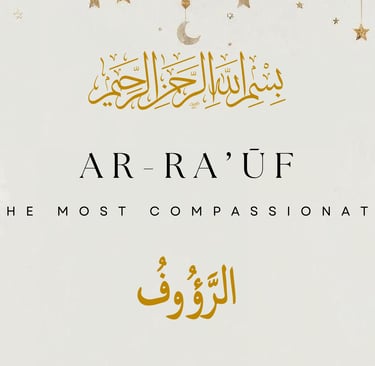
Today we reflect on Ar-Ra’ūf (الرَّؤُوف) — The Most Compassionate, The Tenderly Merciful.
Day 9 – الرَّؤُوف (Ar-Ra’ūf)
The Most Compassionate
Qur’anic Anchor
“Indeed, Allah is Gentle and Compassionate toward people.”
(Qur’an 9:117)
Reflection
Allah calls Himself Ar-Ra’ūf, the Kind, the Compassionate. He bestows mercy with the utmost tenderness. Ar-Ra’ūf meets us with gentle mercy. He warns us softly, withholds what would harm us, and guides us toward what is good, often in ways we do not immediately understand. It is preemptive compassion, a tenderness that protects you from harm or eases your burden before it even has the chance to overwhelm you.
While Ar-Raḥmān is the broad ocean of mercy, Ar-Ra’ūf is an intense, refined, delicate compassion directed at our vulnerability. It is tenderness in response to weakness, a mercy that notices the fragile places, the tired places, the stretched places, and responds with care.
Allah calls Himself Ar-Ra’ūf, the Kind, the Compassionate. He bestows mercy with the utmost tenderness. Ar-Ra’ūf meets us with gentle mercy. He warns us softly, withholds what would harm us, and guides us toward what is good, often in ways we do not immediately understand. It is preemptive compassion, a tenderness that protects us from harm or eases our burden before it even has the chance to overwhelm us.
While Ar-Raḥmān is the broad ocean of mercy, Ar-Ra’ūf is an intense, refined, delicate form of compassion specifically directed at our vulnerability. It is tenderness in response to weakness, a mercy that notices the fragile places, the tired places, the stretched places, and responds with care.
Tafsīr literature often connects this Name to easing after strain—the gentleness that comes after hardship, the softness that follows pressure, the relief that arrives after endurance. It is the Divine response to the exhaustion of the human soul.
Now clinically, here is the heart of it:
Compassion follows recognition of limits.
And it allows the system to soften without collapse.
What does that mean?
Many people treat limits like failure. They meet tiredness with pressure. They meet overwhelm with shame. They meet their humanity with harshness. And the nervous system responds by tightening: more anxiety, more irritability, more avoidance, more shutdown. That’s what “collapse” can look like—when the system is pushed beyond capacity.
But compassion begins when we tell the truth:
“I am stretched.”
“I am tired.”
“I am reaching my limit.”
“This is hard for me.”
When limits are recognised instead of denied, something in the body softens. The nervous system stops fighting reality. The person becomes more regulated. And that softness does not mean you fall apart—it means you become supported enough to stay intact.
This is why compassion is not indulgence. It is regulation. It is wisdom.
In therapy, I often bring this in through the idea of shared humanity—especially in couples conflict and marriage work. Because in many conflicts, both partners are hurting. Both are carrying pain. But when each person is defending their own wound, they can only see the other as the problem. And so the cycle escalates: blame, criticism, shutdown, counterattack.
So I pause the cycle and name the vulnerability underneath:
“You’re not angry because you enjoy anger—your nervous system is protecting something.”
“And you’re not withdrawing because you don’t care—your system is overwhelmed and trying not to explode.”
Then I invite a different posture:
Instead of “who is wrong?” we ask, “where are we tender?”
Instead of “prove your point,” we try: “show me your pain.”
Ar-Ra’ūf invites us to recognize that our weakness is not a flaw to be hidden, but a place where Divine Tenderness meets us.
Ar-Ra’ūf reflects tenderness in response to vulnerability. It goes beyond general mercy (raḥmah) by acting as preemptive compassion, protecting us from harm, easing our burden, or alleviating suffering before it overwhelms us.
When we recognize that the "other" is also fragile, the "shared humanity" of their pain allows the defensive walls to drop. Compassion is what soothes that pain.
This is "Ra’ūf" in clinical language: tenderness toward vulnerability—yours and theirs. Self-compassion and shared compassion soothe pain. And when pain is soothed, people can actually listen, repair, and reconnect.
So your du‘ā today is simple:
O Ar-Ra’ūf, meet my limits with gentleness.
Meet my tiredness with mercy.
Meet my weakness with tenderness.
Teach me to respond to myself the way You respond to me.
As-salāmu ‘alaykum wa raḥmatullāhi wa barakātuh.
Du‘ā Prompt
“O Ar-Ra’ūf, meet my limits with gentleness. Ease my heart where it feels strained.”
Action Prompt
When you notice fatigue today—physical, mental, or emotional—respond with tender care rather than self-pressure.

Hauwa Bello, psychotherapist
My office
No 7, Christian Chukwu Street, 1421 Road, Gwarinpa Estate. Gwarinpa. Abuja. FCT