Khair Always In shaa Allah!

Ramadan Day 20
Day 20 closes the Arc of Forgiveness with Aṣ-Ṣabūr, the Perfectly Patient, and it is the perfect bridge into the last ten days. This reflection reframes patience as strength, not passivity. Clinically, we define patience as the capacity to tolerate discomfort without regressing, staying steady long enough for new patterns to take root. If you have been tempted to quit, rush, or escape discomfort, today invites you to pause, breathe, and endure with purpose as we prepare for the days of liberation.
RAMADAN 2026/1447
Hauwa Bello
3/9/20263 min read

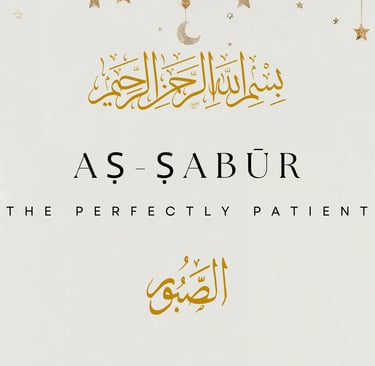
Alhamdulillāh, Day 20. Today we complete the second act of this Ramadan journey, and we are ending it with a Name that fits perfectly: Aṣ-Ṣabūr (الصَّبُور), The Perfectly Patient.
As-salāmu ‘alaykum wa raḥmatullāhi wa barakātuh.
Allah is Aṣ-Ṣabūr. The One with perfect patience and endurance. He is not hasty in His actions. He waits for the proper time. He has full power to punish those who do wrong, yet He gives time, gives room, gives respite, so the servant can repent, change course, and return to the right path.
Isn’t this the best Name to end the act of forgiveness? Yes. Because it reminds us that Allah’s patience is not weakness. It is mercy with wisdom. It is restraint with purpose. It is time given so you can become better, not time given so you can become careless.
And this is why Aṣ-Ṣabūr is not only something we admire about Allah. It is something we are called to practice.
Aṣ-Ṣabūr reflects restraint in the presence of provocation and delay. Scholars emphasise endurance without rebellion. Not endurance that is bitter. Not endurance that is resentful. But endurance that stays steady, stays grounded, and keeps choosing what is right.
Clinically, this translates into a simple, strong definition:
Patience is the capacity to tolerate discomfort without regressing.
Patience is the capacity to tolerate discomfort without regressing.
Because consequences unfold slowly. Growth unfolds slowly. Healing is nonlinear. It comes in waves. Some days are high. Some days are low. And if we only stay committed on the “high” days, change will never last. Change becomes real when we learn how to stay present on the hard days.
This is why, in therapy, I remind clients that growth requires patience because growth is slow. Recovery is not a straight line. A person will have cravings, urges, old triggers, emotional flooding, setbacks, and moments of doubt. The goal is not to never feel discomfort. The goal is to feel discomfort without escaping into old patterns.
So when someone is working on sobriety or any compulsive habit, patience becomes a daily skill. Cravings come. Restlessness comes. Irritability comes. The mind starts negotiating. The body wants relief. And that is where patience is tested. Patience is staying steady in that discomfort long enough for the urge to pass and for the new pattern to strengthen.
And the same applies to emotional habits.
If someone has been quick to lash out and is learning restraint, patience is not only “I didn’t shout today.” Patience is what happens inside the body in the seconds before the reaction. The heart is racing. The chest is tight. The mind is firing. And yet you choose containment instead of escalation. You stay with the heat without becoming the heat. You breathe. You pause. You delay. You choose the replacement behaviour you have committed to.
That is patience. That is maturity. That is Aṣ-Ṣabūr showing up in a human nervous system.
And this is why this Name is also the perfect bridge into the last ten days.
Because the last ten days require endurance. They require staying steady when sleep is calling, when energy is low, when life is still life, and yet you want to seek Laylat al-Qadr. To pray more. To wake for tahajjud. To keep Qur’an. To keep dhikr. To keep your tongue clean. To stay intentional. That takes patience.
Not just patience with worship, but patience with your own process. Patience with imperfect consistency. Patience with gradual growth. Patience with the fact that change takes root quietly before it becomes visible.
So today, make this your du‘ā:
O Aṣ-Ṣabūr, strengthen me to remain steady while change takes root.
Strengthen me to stay present through discomfort.
Strengthen me to endure without regressing.
Strengthen me to keep returning without quitting.
Āmīn.
And your action prompt today is simple and practical:
When discomfort arises today, resist the urge to escape it immediately.
Pause. Breathe. Stay present for a few moments longer than you normally would. Let that be your training.
May Allah strengthen us to make the best use of the last ten days. May Allah make us among those who meet Laylat al-Qadr with sincerity. May Allah grant us steadfastness, and accept from us. Āmīn.
Khayr always. See you tomorrow, in shā’ Allāh.
Day 20 – الصَّبُور (Aṣ-Ṣabūr)
The Perfectly Patient
Qur’anic anchor
“Indeed, Allah is with the patient.”
(Qur’an 2:153)
Reflection
Aṣ-Ṣabūr reflects restraint in the presence of provocation and delay. Scholars emphasise endurance without rebellion. Psychologically, patience is the capacity to tolerate discomfort without regressing. Consequences often unfold slowly. Growth requires staying present through them.
Du‘ā prompt
“O Aṣ-Ṣabūr, strengthen me to remain steady while change takes root.”
Action prompt
When discomfort arises today, resist the urge to escape it immediately.


Hauwa Bello, psychotherapist
My office
No 7, Christian Chukwu Street, 1421 Road, Gwarinpa Estate. Gwarinpa. Abuja. FCT