Khair Always In shaa Allah!

Ramadan Day 18
Day 18 brings us to As-Samī‘, the All-Hearing, and it is a powerful accountability check in the Arc of Forgiveness. This reflection reminds us that careless speech is not neutral, because Allah hears what we say out loud and what we repeat inside ourselves. Clinically, we explore how language shapes internal direction. Speech rehearses action, and integrity begins with the words we choose. Today invites a pause before speaking, so our tongue and inner voice align with our values.
RAMADAN 2026/1447
Hauwa Bello
3/7/20262 min read

Alhamdulillāh, Day 18.
As-salāmu ‘alaykum wa raḥmatullāhi wa barakātuh.
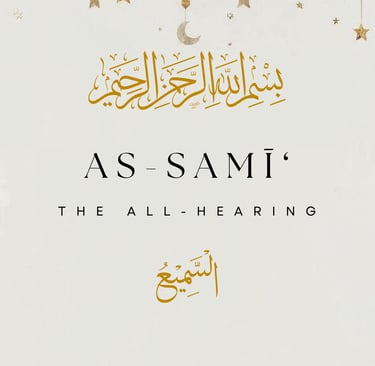
Today we reflect on As-Samī‘ (السَّمِيع), The All-Hearing.
Allah is As-Samī‘. The One who hears everything. The One who hears every du‘ā. The One who hears all voices in all their languages, and all their many needs. He is the All-Hearing, the Ever-Listening. His hearing comprehends everything perfectly, eternally, and without limit.
Allah hears every word. He hears what is said out loud and what is held silently. As-Samī‘ encompasses spoken words and unspoken intentions. Even when you cannot find the sentence, even when you can only sigh, even when you do not know how to explain, Allah hears.
And this Name reminds us of something scholars often highlight:
Careless speech is not neutral.
Because Allah hears, and everything is recorded. Words matter. Not only the words we say to others, but the words we say to ourselves.
Now clinically, this bridge becomes very clear:
Language shapes internal direction.
There is power in language. What you repeatedly say becomes what you repeatedly believe. What you repeatedly believe becomes what you repeatedly choose. And what you repeatedly choose becomes your pattern.
This is why accountability includes monitoring speech, both outward speech and inward speech, because speech rehearses action.
What you say to yourself shapes what you permit, what you tolerate, what you attempt, and what you avoid.
What you say to others shapes what you build, what you damage, what you repair, and what you invite into your relationships.
And that is why in therapy I am quick to pause disempowering statements and cognitive distortions.
When a client says, “I’m hopeless.”
Or “This will never change.”
Or “I always fail.”
Or “Nobody cares.”
We slow down and ask, is that truth, or is that pain speaking? We reframe. We return to wise mind. We hold the emotion with compassion, and we also hold the facts with clarity. When we pair emotional experience with rational truth, the person becomes steadier, healthier, and more able to act in line with their values.
This is why values work matters too. When you know your core values, you can ask a simple question:
Does my speech reflect my values?
Because the goal is not only to be “nice.” The goal is to be congruent. To be true. To live with integrity. And speech is one of the first places integrity shows up.
So today, we call on Allah with a du‘ā that is both spiritual and practical:
O As-Samī‘, discipline my speech so it reflects my values.
Discipline my tongue.
Discipline my inner voice.
Let my words align with who I am trying to become.
And your action prompt today is:
Pause before speaking, and ask whether your words move you toward integrity.
Not toward ego. Not toward impulse. Not toward defence. Toward integrity.
As-salāmu ‘alaykum wa raḥmatullāhi wa barakātuh. Khayr always, in shā’ Allāh.
Day 18 – السَّمِيع (As-Samī‘)
The All-Hearing
Qur’anic anchor
“Indeed, You are the All-Hearing, the All-Knowing.”
(Qur’an 2:127)
Reflection
As-Samī‘ encompasses spoken words and unspoken intentions. Scholars note that careless speech is not neutral. Psychologically, language shapes internal direction. Accountability includes monitoring what we say, to ourselves and others, because speech rehearses action.
Du‘ā prompt
“O As-Samī‘, discipline my speech so it reflects my values.”
Action prompt
Pause before speaking today and ask whether your words move you toward integrity.


Hauwa Bello, psychotherapist
My office
No 7, Christian Chukwu Street, 1421 Road, Gwarinpa Estate. Gwarinpa. Abuja. FCT