Khair Always In shaa Allah!

Ramadan Day 16
Day 16 marks the midpoint of Ramadan and brings us into Al-‘Adl (The Utterly Just) as the Arc of Forgiveness deepens. This reflection explores how divine justice is never harshness, but balance. Nothing is overlooked, and nothing is unfairly weighted. Clinically, we learn that justice stabilises the moral self. Avoiding responsibility fractures integrity, but accepting fair consequences restores internal alignment and reduces repetition. Today invites a blame-free honesty that strengthens the heart and makes real change possible.
RAMADAN 2026/1447
Hauwa Bello
3/5/20262 min read

Alhamdulillāhi Rabbil ‘Ālamīn, Day 16. We have crossed the midpoint of Ramadan, and we are moving through the second half of the month with more intention, more honesty, and deeper refinement.
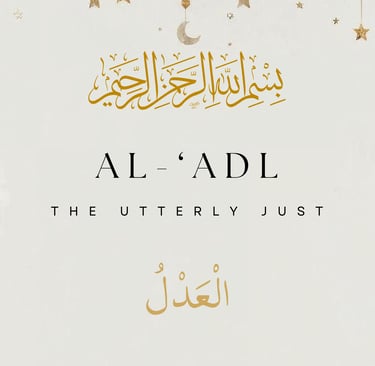
Today we reflect on Al-‘Adl (الْعَدْل), The Utterly Just.
Allah is Al-‘Adl, the embodiment of justice. The Just One. The One who rectifies and sets matters straight in a fair and equitable manner. He is entitled to do what He does. He delivers absolute justice through His wisdom without failure. He gives each person what they deserve and puts everything in its proper order.
Al-‘Adl affirms that nothing is overlooked or unfairly weighted. Scholars emphasise balance here. No excess punishment, and no ignored harm. Nothing is missed. Nothing is dismissed. Nothing is carried unjustly. Allah is perfectly just.
And in the context of forgiveness, this is important. Divine justice is not about harshness. It is about equilibrium. The soul can rest because it knows the scales are true.
Now, psychologically, this Name carries a powerful truth:
Justice stabilises the moral self.
When we avoid responsibility, we fracture integrity. Responsibility goes hand in hand with congruence, that feeling of being one piece, where the inside and the outside match. When we deny the consequences of our actions, something inside us becomes divided. We feel it. People feel it. It creates inner conflict, and inner conflict is exhausting. It often produces anxiety, defensiveness, and repetition.
But accepting fair consequence restores internal alignment and prevents repetition.
This is why in therapy I remind clients, everything we do has consequences. And when we accept fair consequences without resentment, we become more congruent. We live with clarity. We become steadier. We become more reliable to ourselves. And often, we stop repeating what we do not want to keep paying for.
Let’s make it practical, especially for habits and self-discipline.
If someone is battling a negative habit and wants to stop, one method is to attach a fair consequence. Not a punishment rooted in shame. A structured consequence rooted in accountability.
For example, if the habit is lying, a person might choose:
Every time I lie, I will give a specific amount as sadaqah.
Every time I lie, I will pray two extra nawāfil.
Every time I lie, I will do a specific corrective action.
What happens over time is simple. Repetition becomes costly. If you lie ten times and now you owe ten rounds of that consequence, you feel the weight. And because the consequence is consistent and fair, the habit begins to reduce. Not through self-hatred, but through structure. Not through shame, but through moral clarity.
Different people will choose different consequences, but the principle remains:
Accepting fair consequences builds justice into the nervous system.
It stabilises the moral self. It reduces self-deception. It restores integrity.
Because if we are not true to ourselves, we cannot feel settled inside ourselves. Lack of congruence is exhausting. That is why Al-‘Adl is not only a Name to admire. It is a Name to live by.
So your du‘ā today is:
O Al-‘Adl, help me accept responsibility without resentment.
Help me be just to myself and to others.
Help me live aligned.
Āmīn.
Till tomorrow, in shā’ Allāh. Khayr always.
Day 16 – الْعَدْل (Al-‘Adl)
The Utterly Just
Qur’anic anchor
“The word of your Lord is complete in truth and justice.”
(Qur’an 6:115)
Reflection
Al-‘Adl affirms that nothing is overlooked or unfairly weighted. Scholars emphasise balance: no excess punishment, no ignored harm. Psychologically, justice stabilises the moral self. Avoiding responsibility fractures integrity. Accepting fair consequence restores internal alignment and prevents repetition.
Du‘ā prompt
“O Al-‘Adl, help me accept responsibility without resentment.”
Action prompt
Acknowledge one consequence today without blaming others or circumstances.


Hauwa Bello, psychotherapist
My office
No 7, Christian Chukwu Street, 1421 Road, Gwarinpa Estate. Gwarinpa. Abuja. FCT