Khair Always In shaa Allah!

Ramadan Day 13
A closing step in the Arc of Forgiveness. After the moral clarity of Al-Ghafūr (naming harm) and the strategic shift of Al-Ghaffār (interrupting patterns), Day 13 brings us to Al-‘Afūw, the One who erases. This reflection helps us distinguish between a struggle we are still working through and a transgression we have truly turned away from. Because in healing, real lightness comes after accountability, repair, and sincere return.
RAMADAN 2026/1447
Hauwa Bello
3/2/20263 min read

Alhamdulillāh, Day 13.
As-salāmu ‘alaykum wa raḥmatullāhi wa barakātuh.
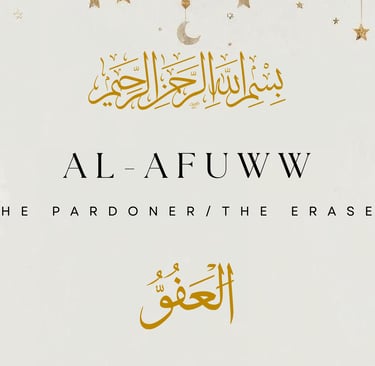
Today we reflect on Al-‘Afūw (العَفُوّ), The One Who Erases.
Day 13 — العَفُوّ (Al-‘Afūw)
The One Who Erases
Qur’anic Anchor
“Indeed, Allah is Pardoning and Forgiving.”
(Qur’an 4:149)
Reflection
Allah is Al-‘Afūw, the One who removes and erases sins, mistakes, errors, faults, and wrong choices, then becomes pleased with the servant who returns. Al-‘Afūw is not only the One who forgives. He is the One who can blot out, the One who can leave no trace.
And that distinction matters.
Because Al-‘Afūw signifies erasure after sincere return. Tafsīr highlights the removal of traces, not the denial of the act. It is not pretending it never happened. It is Allah clearing the record and lifting the stain after a genuine turning back.
Al-Afuww completely blots out sins, making the mistake or fault disappear entirely as if it never existed. He is the Pardoner and the Effacer who leaves no trace of the transgression behind. In classical terms, this signifies an erasure that follows a sincere return. It is the removal of the "stain," not a denial of the act, but a complete clearing of the record once the heart has truly turned away.
Now let’s bring it into our inner work.
Erasure follows accountability.
Erasure follows accountability.
We cannot “wipe the slate clean” by skipping responsibility. That is not release. That is suppression. It is like sweeping dirt under a carpet. The house is not clean. The dirt is just hidden, waiting to resurface.
Skipping responsibility leads to suppression, not freedom.
This is why release only comes after repair, not before.
And we see this clearly in therapy. When someone has been harmed, especially in severe trauma, it is very difficult for the nervous system to settle when the person who caused harm is not accountable, not remorseful, and not seeking repair. Accountability matters. Repair matters. Without it, the body does not register safety, so the wound stays active.
So sometimes, in human relationships, forgiveness can look like release without closeness. Letting go of being consumed, while still keeping boundaries. Forgive if possible, but you do not have to forget, and you do not have to keep the person close.
In cases of deep trauma, such as assault, it is incredibly difficult for a victim to "erase" the effects if the perpetrator is not genuinely remorseful or accountable. In these external cases, we often seek forgiveness of distance—forgiving to release the self, but keeping the other at arm's length.
Now bring it back inward.
When it comes to forgiving ourselves, the same principle holds. To truly release, we first take responsibility. We name what we did. We acknowledge the impact. We repair where possible. Because without accountability, what people often call “forgiveness” becomes avoidance. And avoidance is not freedom.
Freedom is when we can say, with sincerity:
I owned it.
I repented.
I repaired what I could.
I turned away.
I am not going back.
That is where Al-‘Afūw becomes especially meaningful. Not only “forgive me,” but: “erase what I have truly turned away from.” Cleanse my heart of its traces. Lift its weight.
So our du‘ā today can be simple:
Du‘ā Prompt
O Al-‘Afūw, erase what I have truly turned away from.
Erase it from my record.
Erase its stain.
Erase its weight.
And help me live in the lightness of repentance.
And yes, as we keep learning these Names, we keep drawing near. The more we understand, the more we return with clarity and love, day by day.
Action Prompt
Where possible, take one reparative action today.
An apology, a correction, or a restraint. Something that helps you carry responsibility instead of skipping it.
See you tomorrow, in shā’ Allāh.
As-salāmu ‘alaykum wa raḥmatullāhi wa barakātuh.

Hauwa Bello, psychotherapist
My office
No 7, Christian Chukwu Street, 1421 Road, Gwarinpa Estate. Gwarinpa. Abuja. FCT