Khair Always In shaa Allah!

Ramadan Day 12
Alhamdulillāh, Day 12. We move from the moral clarity of Day 11, where we named our truths, into the territory of patterns. While Al-Ghafūr covers the weight of sin, Al-Ghaffār meets us in repetition and teaches us that repeated return is not shameful; it is the path. This post bridges spiritual forgiveness with a key clinical truth: insight is not enough. Real change comes when we pair honesty with strategy and begin to interrupt the cycle with one small, deliberate shift.
RAMADAN 2026/1447
Hauwa Bello
3/1/20263 min read

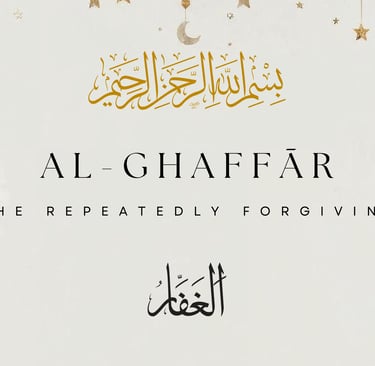
Alhamdulillāh, Day 12.
As-salāmu ‘alaykum wa raḥmatullāhi wa barakātuh.
Today, we reflect on Al-Ghaffār (الغفّار), The Repeatedly Forgiving, the Name Allah uses in this āyah.
Qur’anic Anchor
“And indeed, I am the perpetual forgiver of whoever repents…”
(Qur’an 20:82)
Reflection
If yesterday taught us that forgiveness follows acknowledgement, today deepens the lesson: forgiveness is not only about isolated mistakes. It is also about patterns.
Al-Ghaffār is the One who forgives repeatedly, over and over, as long as we keep turning back. He veils faults again and again. He protects us from being crushed by shame and guilt. And by His mercy, when repentance is sincere and return is real, Allah can even transform wrong deeds into good deeds.
Al-Ghaffār is the One who forgives repeatedly and perpetually. While we often fear that our "same old mistakes" will eventually exhaust the Divine patience, this Name tells us the opposite.
Scholars emphasise something important here: repeated return, not repeated denial.
Not “I know it’s wrong, but I refuse to face it.”
But “I fell again, and I’m coming back again.”
So the question is not, “Will Allah get tired of me?”
The question is, “Will I keep returning, and will I return with honesty and effort?”
Even more miraculous is the capacity of Al-Ghaffār to transform: He can take our wrong deeds and, through the process of sincere return, turn them into good deeds. Scholars emphasize that this is a call for repeated return, not repeated denial. We don't hide the pattern; we bring it into the light of the Perpetual Forgiver.
Clinically, this has a very clear translation:
Insight without behavioural change sustains the cycle.
It is one thing to understand the pattern.
It is another thing to interrupt it.
That is why therapy does not stop at insight. We follow insight with behavioural change. We test strategies. We practise small experiments. We build structure. We try again. Because if we only understand our wounds but keep the same behaviours, we stay in the same pain. We sustain the very cycle that brought us into the work in the first place.
Here is the key reframe for today:
Forgiveness is not permission to continue. It is an opportunity to interrupt.
When a pattern repeats, the call is not despair. The call is strategy.
Repetition does not mean you are doomed. It means you need a new plan. A new structure. A new response. A new support. A different way of handling the trigger, the urge, the stress, the relational dynamic, whatever keeps feeding the loop.
In sessions, when a strategy fails, we do not collapse into hopelessness. We return to the table. We refine. We try again. We keep doing something different until the cycle begins to shift.
That is the clinical mirror of Al-Ghaffār. As Allah continues to forgive, we are called to continue returning, and to keep improving our strategy so the return becomes a path of growth, not a loop of despair.
Forgiveness is not a permission slip to continue a harmful habit; it is a strategic opportunity to interrupt it. When we find ourselves repeating a mistake—whether it is an addiction, a reactive temper, or a self-sabotaging behavior—it is a signal that we need a new strategy, not more despair.
Du‘ā Prompt
“O Al-Ghaffār, help me change what I keep returning to. Help me interrupt what has become repetitive. Help me build a new path where I keep falling back into an old one.”
Action Prompt
Identify one repeating pattern. Then write one small strategy you will try today to interrupt it. Keep it simple and specific.
Example: “If I feel the urge to ___, I will first ___ for five minutes.”
See you tomorrow, in shā’ Allāh. Take care.

Hauwa Bello, psychotherapist
My office
No 7, Christian Chukwu Street, 1421 Road, Gwarinpa Estate. Gwarinpa. Abuja. FCT