Khair Always In shaa Allah!

End-of-Week Reflection: Building Your Fortress of Safety
An end-of-week pause to help you see what Allah has been building in you. This reflection gathers Days 1–5 into one cohesive Fortress of Safety—from mercy and repair, to subtle growth, to love that sustains, and nearness that quiets the fear of being alone. Read this to integrate the week, name your strongest anchor, and steady your heart for what comes next. This End-of-Week Reflection is both a pause and a pivot, helping you see the structure we’ve been building, day by day, through the first five days of Ramadan.
RAMADAN 2026/1447
Hauwa Bello
2/22/20262 min read

As-salāmu ‘alaykum wa raḥmatullāhi wa barakātuh. We have completed the first five days of our journey together, and I want us to pause and look at the architecture of the heart we have been building.
In my practice, I often tell clients that healing is like building a home: you cannot decorate the rooms until the foundation is poured and the walls are steady. These first five Divine Names are not just ideas—we have been living them as structural pillars for our internal Fortress of Safety.
Here is how they have worked together to stabilise you this week:
1) The Foundation: Ar-Raḥmān (The Entirely Merciful)
We began with the “floor” we stand on. Ar-Raḥmān is mercy that precedes every action you take. It taught us a vital clinical principle: safety before demand. Before you asked anything of yourself this Ramadan, you were already held in a mercy that is not reactive to your performance.
We begin held by Allah's Mercy, not pressured
2) The Bridge: Ar-Raḥīm (The Especially Merciful)
If Ar-Raḥmān is the floor, Ar-Raḥīm is the hand that reaches for us when we slip. This Name introduced repair without abandonment. It reminded us that growth doesn’t happen because failure ends, but because the connection remains intact every time we return.
Growth happens because the connection remains intact every time we return.
3) The Invisible Support: Al-Laṭīf (The Subtly Kind)
Change is often invisible while it is happening. Al-Laṭīf gave us tolerance for ambiguity. Like the metaphor of the hammer hitting the stone, we learned to trust that the “quiet” work is happening beneath the surface, even when we cannot yet see results.
Trusting that the quiet work is happening beneath the surface, even when we can’t yet see results.
4) The Fuel: Al-Wadūd (The Most Loving)
We moved from safety into active affection. Al-Wadūd challenged the narrative of conditional worth. We learned that love is not a reward for your self-improvement—it is the sustaining force that enables you to keep improving in the first place.
Love is what sustains the capacity to improve.
5) The Presence: Al-Qarīb (The Ever-Near)
Finally, we addressed the fear of being alone. Al-Qarīb counters our abandonment schemas by affirming that we are never calling out into a void. You are always speaking within proximity to a Creator who is near—indeed, Allah reminds us that He is closer to us than our jugular vein (Qur’an 50:16).
We are always speaking within proximity to the One who is near.
A Moment for Integration
Take a look at these five pillars. Notice how they move you away from the survival mode of self-criticism and into a steadier place of felt security.
Reflection Question: Which of these five pillars felt the “shakiest” for you this week—and which one felt like the strongest anchor?
Hold onto that answer as we begin a new week and move into Day 6. Let this be your check-in before the new week begins. You aren’t just fasting; you are being rebuilt.
Warmly,
Hauwa Bello
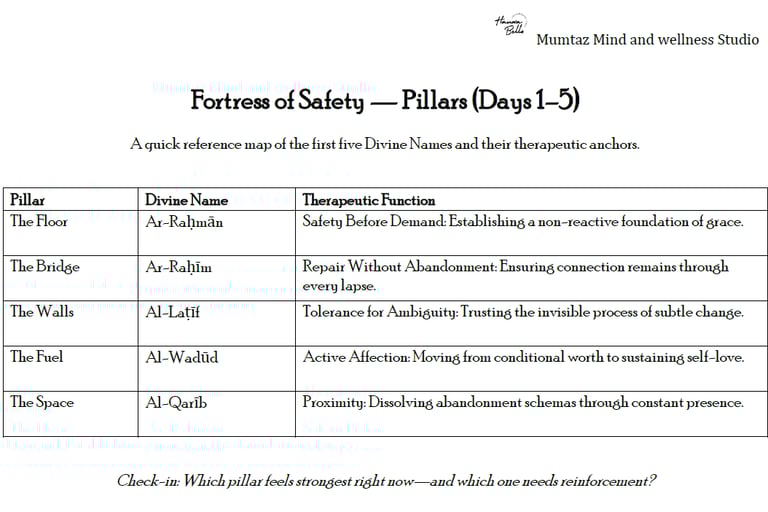
Download this Fortress of Safety map and keep it on your phone or at your desk. Whenever you feel the urge to slip into self-criticism today, look at these pillars and remind your nervous system: I am safe, I am seen, and I am not alone.
Hauwa Bello, psychotherapist
My office
No 7, Christian Chukwu Street, 1421 Road, Gwarinpa Estate. Gwarinpa. Abuja. FCT