Khair Always In shaa Allah!

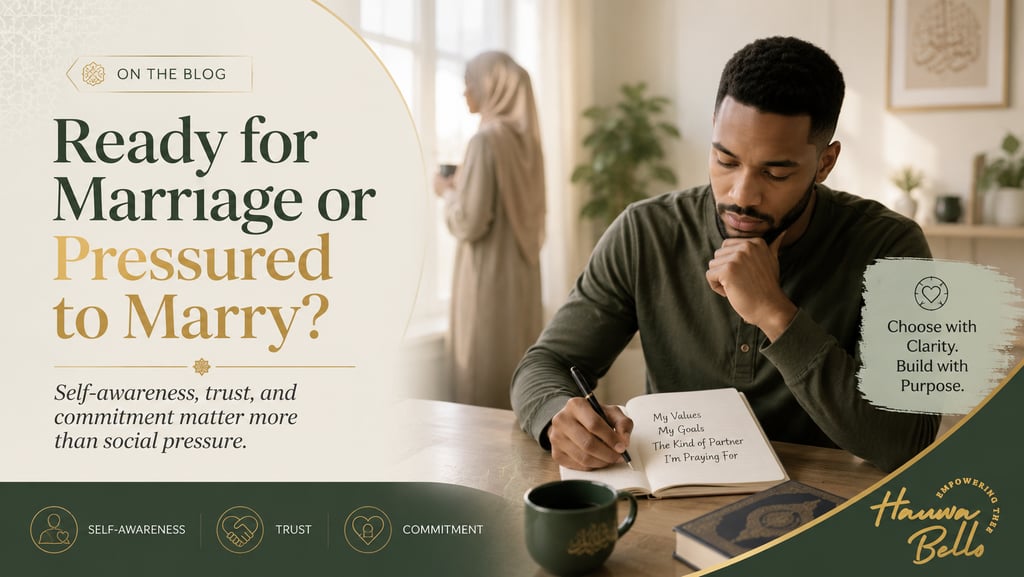
Do You Want Marriage, or Are You Just Feeling Pressured to Get Married?
How do you know you are truly ready for marriage? This post explores why marriage should be chosen with self-awareness, trust, commitment, and clarity, rather than social pressure, age, money, or fear of being left behind.
MARRIAGE AND RELATIONSHIPS
Hauwau Bello
7/3/20269 min read
How Do You Know You Are Ready for Marriage?
A young man in his 30s recently asked me about marriage.
Before answering him, I asked a simple question:
“Why do you want to get married?”
His answer was honest.
He said he felt it was expected of him. Society expects it. He is in his 30s. It is time to have children. People are asking. Life is moving. Marriage seems like the next thing to do.
And I understood him.
Many people arrive at the thought of marriage this way. Sometimes it is family pressure. Sometimes it is age. Sometimes it is loneliness. Sometimes it is desire. Sometimes it is the feeling that everyone else is moving forward and you are standing in one place.
But I told him something important.
You should not get married simply because society expects you to get married.
You should get married because you have reached a place of readiness. You should get married because you understand what marriage requires. You should get married because you have found someone you can choose with clarity, commitment, trust, and responsibility.
Marriage is too important to enter only because people are asking, “When will you marry?”
It is too sacred to enter only because your mates are already married.
It is too demanding to enter only because you now have money.
It is too serious to enter only because you want children.
It is too deep to enter only because you feel lonely.
And it is too much of an amanah to enter only because you want to silence pressure.
Marriage is not just an event. It is not only a wedding. It is not only a title. It is not only “my husband” or “my wife.” It is a life you build with another human being before Allah.
So the real question is this:
How do you know you are ready for marriage?
Readiness Is More Than Age
Age matters, but age alone does not create readiness.
A person can be 25 and very emotionally mature. Another person can be 42 and still unable to communicate, take responsibility, regulate emotions, or honour commitment.
Still, age does give us context.
A person in their early 20s may still be discovering themselves. They may still be learning what they value, how they handle conflict, what kind of life they want, how they manage emotions, and what they expect from love, family, money, faith, and responsibility.
This does not mean people in their 20s cannot marry well. Many do. Some build beautiful, stable, God-conscious homes. But at that stage, marriage often requires a lot of humility, guidance, patience, mentorship, and willingness to grow together.
A person in their 30s is usually in a different season. By then, you have lived with yourself for a while. You may understand your temperament better. You may know what kind of life brings you peace and what kind of life drains you. You may have clearer values, clearer preferences, clearer goals, and clearer expectations.
In your 30s, the question becomes more serious:
Do I know myself well enough to choose wisely?
Because at this stage, many people are thinking about children, family stability, career direction, and long-term responsibility. You may still have time, of course, but you may also be making decisions that affect children sooner. And children deserve to be born into a relationship that has some level of emotional safety, stability, and sincerity.
For people in their 40s and beyond, readiness may come with another kind of clarity. At this stage, many people already have established lives. Some may have children. Some may have gone through heartbreak, divorce, grief, disappointment, or long seasons of waiting. The question may shift from “Can we start a life?” to “Can we blend our lives with wisdom, peace, and mercy?”
So yes, different seasons of life may come with different considerations.
But at every age, the foundation remains the same:
You need self-awareness.
You need emotional maturity.
You need spiritual responsibility.
You need the capacity to commit.
You need the ability to choose wisely.
Money Alone Does Not Mean You Are Ready
One of the things this young man told me was that people had said he would know he was ready for marriage when he had the financial means to marry.
There is some truth here.
Financial responsibility matters. A person preparing for marriage should think seriously about provision, stability, planning, and the practical demands of family life. Marriage requires food, shelter, clothing, healthcare, transport, school fees one day, and the daily expenses of running a home.
So money matters.
But money alone is not readiness.
Having money does not automatically make someone kind.
Having money does not automatically make someone faithful.
Having money does not automatically make someone emotionally safe.
Having money does not automatically make someone responsible with anger, ego, communication, or conflict.
A person may be financially stable and still be selfish, harsh, controlling, dishonest, emotionally unavailable, or deeply unprepared for partnership.
And another person may still be building financially, but they may have sincerity, discipline, responsibility, emotional maturity, a clear plan, and a heart that understands the amanah of marriage.
So we should be careful. Financial readiness is part of marriage readiness, but it is not the whole story.
Money can support a marriage. It cannot carry the whole marriage.
Desire Alone Does Not Mean You Are Ready
Another answer he had heard was that a person is ready to marry when they start having sexual feelings or desire.
Again, there is a truth here.
In Islam, marriage is one of the halal ways Allah has given us to honour desire, protect chastity, build family, and experience companionship. Desire is natural. It is part of being human.
But desire alone does not mean a person is ready for marriage.
Marriage is not only about desire. It is about responsibility. It is about mercy. It is about patience. It is about amanah. It is about living with another person in their strengths and weaknesses. It is about waking up on days when feelings are low and still choosing kindness. It is about handling disappointment without cruelty. It is about disagreement without humiliation. It is about being trusted with another person’s heart, body, dignity, secrets, family, and future.
Desire may make a person want marriage.
Maturity helps a person sustain marriage.
You Are Ready When You Know Yourself
One of the first signs of marriage readiness is self-awareness.
Before asking, “Who should I marry?” it is wise to ask, “Who am I?”
What kind of person am I when I am angry?
How do I respond when I feel misunderstood?
Can I apologise sincerely?
Can I take correction without becoming defensive?
What are my emotional needs?
What are my patterns?
What are my fears?
What are my values?
What kind of home do I want to build?
What does deen mean to me in daily life?
What do I expect from a spouse?
What do I have the capacity to give?
What am I still healing from?
Which parts of me may make marriage difficult if I leave them unattended?
Many people spend more time thinking about the kind of spouse they want than the kind of spouse they are becoming.
But marriage will reveal you.
It will reveal how patient you are. It will reveal how forgiving you are. It will reveal how you speak when you are upset. It will reveal your relationship with money. It will reveal your expectations around gender roles, affection, family, privacy, loyalty, and responsibility.
Marriage does not only give you a partner. It gives you a mirror.
So before you choose someone, know yourself.
Because when you know yourself, you are more likely to know who complements you.
You Are Ready When You Know What You Are Looking For
When you understand yourself, you become clearer about the kind of person who can walk with you.
This does not mean creating an unrealistic list.
It does not mean demanding perfection.
It does not mean expecting someone to have every quality you admire.
It means knowing your essentials.
There are basic things that should matter deeply. Faith. Character. Emotional safety. Honesty. Respect. Responsibility. Kindness. Shared values. Willingness to grow. The ability to communicate. The ability to take accountability. A similar direction in life.
Then there are secondary preferences. Things you may like, but can be flexible with. Personality style. Certain hobbies. Tribe. Height. Specific career type. Some lifestyle preferences. Certain family expectations. These may matter to you, but they should be weighed with wisdom.
The danger is when someone sacrifices the essentials because the secondary things look attractive.
Someone may look good, speak well, have money, come from a respected family, or appear religious in public. But can you trust them? Are they kind when disappointed? Do they respect boundaries? Can they listen? Do they honour people beneath them? Are they truthful? Are they emotionally safe?
There should be a pass mark for the things that matter most.
No one will score 100 percent. You will not score 100 percent either.
But there are minimum standards that should be present before marriage.
You Are Ready When You Can Choose With Clarity, Not Panic
Many people do not choose marriage from clarity. They choose it from fear.
Fear of ageing.
Fear of being left behind.
Fear of what people will say.
Fear of disappointing parents.
Fear of losing a person.
Fear of starting again.
Fear of remaining single.
Fear can push people into decisions they have not properly thought through.
But fear is a poor foundation for marriage.
A better question is:
If nobody was pressuring me, would I still choose this person?
If I was not afraid of my age, would I still choose this person?
If I was not trying to prove a point, would I still choose this person?
If I was calm, grounded, and honest with myself, would I still say yes?
Marriage should be entered with seriousness, not panic.
Pressure can make you rush.
Readiness gives you steadiness.
You Are Ready When You Can Trust and Commit
Two pillars are essential in marriage: trust and commitment.
If you cannot trust a person, marriage becomes emotionally exhausting.
You may find yourself monitoring, doubting, checking, fearing, questioning, and living in suspicion. A home without trust becomes a place of tension rather than sakinah.
Trust does not mean you know every detail of the future. Trust means the person has shown enough honesty, consistency, character, and emotional safety for you to feel that your heart, dignity, and future are reasonably safe with them.
Commitment is also essential.
Can you choose this person beyond excitement?
Can you choose them when life becomes stressful?
Can you choose them when they disappoint you in ordinary human ways?
Can you choose repair instead of silent punishment?
Can you choose maturity instead of ego?
Can you choose the marriage even when your mood changes?
Commitment does not mean tolerating harm or abandoning wisdom. It means you understand that marriage requires loyalty, effort, repair, patience, and responsibility.
If you cannot see yourself committing to a person, pause.
If you cannot trust them, pause.
Attraction may bring people close, but trust and commitment help them build.
You Are Ready When You Understand That Marriage Is an Amanah
From an Islamic perspective, marriage is not just companionship. It is an amanah.
You are being trusted with another person.
Their heart is an amanah.
Their dignity is an amanah.
Their body is an amanah.
Their secrets are an amanah.
Their family ties are an amanah.
Their emotional safety is an amanah.
Their spiritual growth is an amanah.
Marriage can be a means of sakinah, mawaddah, and rahmah. It can also become a place of pain when people enter it carelessly, selfishly, or without emotional maturity.
This is why we must treat the decision with seriousness.
Wanting marriage is good.
Praying for marriage is good.
Preparing for marriage is wise.
But entering marriage only because people expect it from you can place you, your spouse, and your future children under unnecessary strain.
Marriage should be chosen with niyyah, clarity, wisdom, and readiness.
So, How Do You Know You Are Ready?
You may be ready for marriage when you can say:
I understand myself better than before.
I know my values.
I know what I need in a spouse.
I know what I can offer as a spouse.
I am willing to grow.
I can take responsibility for my emotions and behaviour.
I am ready to communicate with respect.
I understand that marriage requires patience, mercy, sacrifice, and repair.
I am choosing this person with clarity, not pressure.
I trust this person’s character.
I can commit to building a life with this person.
I believe we share enough core values to move in the same direction.
I am ready to treat marriage as an amanah before Allah.
This does not mean you will have no fear. Most major life decisions come with some fear.
It means your decision is not being driven by fear.
It means you are not just running away from singleness. You are moving toward responsibility.
It means you are not just trying to meet society’s expectations. You are choosing a person, a path, and a life with intention.
Final Reflection
So, before asking, “When will I get married?” maybe we should ask deeper questions.
Am I ready to be trusted with another person?
Do I know myself enough to choose wisely?
Have I healed enough to love with maturity?
Can I communicate, repair, forgive, and take responsibility?
Am I choosing marriage because I am ready, or because I am afraid?
And when you finally meet someone you are considering for marriage, ask yourself:
Can I trust this person?
Can I commit to this person?
Can we build a peaceful, responsible, God-conscious life together?
Because marriage is not only about reaching a certain age.
It is about reaching a certain level of readiness.
And readiness begins with knowing yourself, choosing wisely, and understanding the sacred responsibility of saying, “I want to build a life with you.”

Hauwa Bello, psychotherapist
My office
No 7, Christian Chukwu Street, 1421 Road, Gwarinpa Estate. Gwarinpa. Abuja. FCT